

Daycare Employee Benefits: The Complete Guide for Child Care Owners & Directors
Daycare Employee Benefits: The Complete Guide for Child Care Owners & Directors
Daycare Employee Benefits: The Complete Guide for Child Care Owners & Directors


Most child care and daycare staff are hourly employees, generally limiting their access to benefits that often come with salaried W-2 positions. However, some child care providers do offer extra perks or benefits to employees in hopes of improving staff satisfaction and thereby retention. And oftentimes, self-employed child care directors generally will want a route to give themselves benefits, such as a retirement plan and health insurance.
Directors struggling to keep or grow their staff may want to consider adding benefits to their compensation packages. Offering benefits may be a great way to stand out amongst local competition and earn the hires of the most qualified employees available. In turn, attracting and hiring a great staff could lead prospective families to trust your child care business more than others – and be willing to pay higher tuition.
Below we review what benefits are mandatory and optional in the child care and preschool industry – as well as common cost ranges and considerations – to help you evaluate the costs and benefits of instituting them in your own business.
Many child care directors have improved staff retention and satisfaction by implementing efficient workflows through the Playground app. Book a free demo to learn more.
What benefits are child care businesses legally required to offer?
Some employee benefits are legally mandated by the federal or state government. You’ll want to account for some of these upfront costs when budgeting and making financial projections.
Payroll taxes
Payroll taxes generally include FICA taxes – which covers Social Security and Medicare benefits – as well as charges for unemployment insurance and also any state-specific programs. Contributions may come directly from employee paychecks or require additional payments from employers.
Social Security: Social Security taxes apply to everyone whether full-time or part-time, with each party responsible for half of the payments. The employer and employee each contribute 6.2% of the employee’s income toward Social Security (OASDI) taxes. If you’re a self-employed director paying yourself, you will owe a full 12.4%. These taxes may be capped at a certain income threshold, though the cap will generally not apply to most child care workers.
Medicare: Employers and employees also share the cost of Medicare taxes. The base rate for each is 1.45% of the income.
Unemployment benefits: As an employer, you will owe unemployment insurance taxes to both the federal government and your state. The federal unemployment tax (FUTA) and State Unemployment Tax Act (SUTA) are generally paid by the employer, though some states do require contributions by the employee as well. For FUTA, the maximum payment is 6% on the first $7,000 earned by the employee, with discounts available. SUTA rates vary more depending on your state, history of employees filing for unemployment benefits, and other factors.
Parental leave: In most cases, paid family leave benefits come directly out of employee paychecks. However, the employer typically is responsible for organizing and making payments for these benefits on behalf of their staff. Eligibility for paid family leave may depend on the conditions and length of employment.
Workers’ compensation: Child care or daycare businesses will be required to have a workers’ compensation plan in place, with premiums paid to an insurance company up front in case a worker gets injured or incapacitated on the job. For most small businesses, this cost is less than $100 per month, with costs depending on factors specific to your business and location.
What benefits are common in the child care industry?
In general, most child care or daycare businesses do not offer special benefits to their employees. This is often because many child care businesses employ people part time, and profit margins in this industry tend to be low – leaving little room for perks. It is relatively rare for a preschool or daycare to offer benefits like a 401(k) plan, health insurance, or paid time off. But that does not mean it’s not worth considering. In fact, the most competitive child care businesses offer their employees such benefits.
How many child care and daycare businesses offer employee benefits?
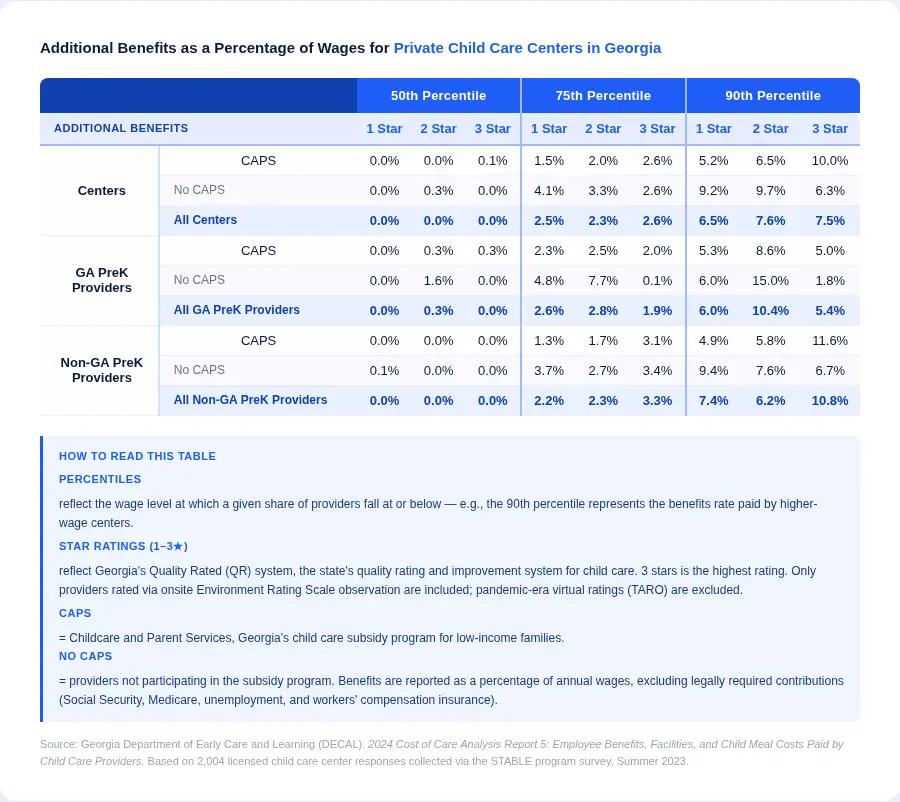
While each business may vary in compensation packages as a result of local competitive dynamics, some benefits data is available for the child care industry. For example, the Georgia Department of Early Care and Learning collected data from over 2,000 child care centers in 2023 to get a sense for how child care worker pay rates and the quality of care correlates with the amount of additional benefits offered to the staff.
One of the biggest findings of the study was that most child care and daycare businesses do not offer any additional benefits to their staff, with most centers offering 0% of wages in the form of benefits like health insurance and retirement plans. However, there does seem to be a relationship between the quality of care and the benefit offerings. Providers who offer higher quality child care – and better wages – were more likely to also offer benefits to their employees.
For example, at the 90th percentile of wages and the highest tier of care, child care providers actually offered 6.5% to 7.6% of employee wages as additional benefits. Outside of Georgia, this average came in highest at 10.8% for the highest tier of care and pay.
Common benefits
If you are struggling to hire or retain your staff, you can consider offering a handful of benefits to stand out among the competition (your fellow local child care providers). Offering benefits can help attract more qualified and experienced employees, who may be looking for compensation that reflects that.
Some potential benefits include:
401(k) / retirement plan. These incentivize long-term employment, especially if an employer match is involved. An employer match generally requires vesting: that the employee stays employed at your facility for a set amount of time to earn the benefit. For the self-employed child care director, a retirement plan could be a great benefit for yourself, as well.
Paid time off. Paid time off (PTO) could be a great way to offer a pressure relief valve to strained employees to recharge without worrying about their budget. Alternatively, holiday pay rates may be of interest to certain employees if you can’t give them PTO due to conflicting requests for time off.
Continuing education. Staff development or continuing education can work toward multiple ends. Not only can it help motivate your staff to feel like they are enriching their own skill sets for future leverage, but it can help you develop and implement higher quality staff for your services. In the right circumstances, you may be able to in turn leverage improved staff development to market your services as higher quality. See options for child care staff development on Playground’s child care vendor map.
Health insurance. Offering a group health insurance plan can be another great perk both for staff and the owner-director. Health insurance is top of mind for many families, especially if you have an older staff that does not qualify for health insurance under their parents (many people aged 26 and under can qualify under their parents’ plan). In a similar vein, Health Spending Accounts (HSAs) or Flexible Spending Accounts (FSAs) might be more affordable ways to offer tax-advantaged health benefits to employees. These allow participants to set aside their own savings into an account which, when used for qualifying medical expenses, avoids income taxes.
Life & disability insurance. Other types of insurance, like life and disability, are often commonly offered in many industries and may be affordable additional benefits you can offer to staff. You can generally take advantage of group pricing discounts where risk is spread across your staff and other businesses.
Savings club. If you are a multi-site location or otherwise often place large supply orders that include bulk discounts, it may make sense to offer your employees the ability to take advantage of those benefits. If this idea seems compelling, you can check out the Playground Savings Club which you can leverage for this purpose.
It will likely make sense to consider who your staff members are and which benefits might be most useful to them, while considering the upfront costs to you and your business.
How much does it cost daycare providers to offer benefits to employees?
The following can serve as a baseline estimate for prices of offering various employee benefits in your preschool or daycare. For many benefits, an accurate quote may require speaking to an insurance agent, financial advisor, or other relevant specialists.
Benefit | Estimated cost | Notes |
401(k) | $500 to $3,000 startup costs; $500 to $4,000+ annually | Tax credits from the Secure 2.0 Act may help cover costs. 401(k) plan costs will vary depending on your circumstances. Offering an employer match will significantly increase costs. You can look into other alternatives like a Safe Harbor 401(k) plan to potentially reduce costs. |
Paid time off | $232.95 per day | Based on the average child care administrator income levels, adjusted to hourly rates and including additional contributions required for FICA taxes. |
Health insurance | Average of $8,435 for a single person and $23,968 for family coverage. | Employers can offer to cover a portion or all of health insurance premiums. This benefit is typically not offered for part-time employees. |
Continuing education | Free to $1,200+ | Continuing education can take many forms, and may depend on whether this activity needs to qualify for official Professional Development (PD) hours or not. Online courses and webinars, as well as conferences, may be good options to explore for continuing education. |
Life insurance | $15 to $150 per month per employee | Life insurance may not be valuable to all of your employees, particularly those without children, but it can otherwise serve as an affordable, predictable benefit offering. |
Disability insurance | Short-term disability: $0.09 per hour worked Long-term disability: $0.05 per hour worked | Plans can be set up to be more protective of the employer or employee, and costs will depend on this and other factors. Both short-term and long-term disability policies may be offered. |
Savings club | Potentially free, or membership fees may be involved | Such benefits may be informally structured depending on what’s available to you. Check out the Playground Savings Club if you want a good place to start. |
After you get specific quotes for your business, consider the potential positive impact of the benefits relative to their cost.
Is it worth offering child care staff benefits?
So what’s the payoff for offering child care staff benefits? As you likely have experienced, employee retention is one of the biggest challenges to running a successful child care business. Keeping staff over a longer time period usually saves money over the long-term by preventing additional recruiting, onboarding, and development cycles for new staff turnover. Some sources put the cost of replacing an employee at 50% to 200% of the employee’s pay, all things considered. Meanwhile, some reports claim that employees who are satisfied with their employer benefits are five times more likely to stay with the employer versus leaving.
Keeping the same staff also helps maintain internal business knowledge over the long-term and build relationships with families and the local community. Retention is perhaps the biggest benefit to your business.
The bottom line
Offering thoughtful employee benefits is one of the most effective ways to attract and retain quality child care staff in a competitive market, ultimately improving care quality, family trust, and your bottom line. While benefits do involve real costs, they are typically outweighed by major savings from reduced turnover, which can cost 50-200% of an employee’s salary to replace. You don’t need to offer everything at once; starting with high-value, affordable options like paid time off, continuing education, or a savings club can deliver meaningful impact.
Another great way to retain employees without breaking the bank is to make their jobs as frictionless as possible. For child care directors, this generally means finding ways to reduce operational inefficiencies in administrative work, including pick up and drop off, subsidy reporting, finances, payroll, marketing and beyond. Consider booking a free demo with Playground to see how software solutions can streamline your business and improve staff retention.
Most child care and daycare staff are hourly employees, generally limiting their access to benefits that often come with salaried W-2 positions. However, some child care providers do offer extra perks or benefits to employees in hopes of improving staff satisfaction and thereby retention. And oftentimes, self-employed child care directors generally will want a route to give themselves benefits, such as a retirement plan and health insurance.
Directors struggling to keep or grow their staff may want to consider adding benefits to their compensation packages. Offering benefits may be a great way to stand out amongst local competition and earn the hires of the most qualified employees available. In turn, attracting and hiring a great staff could lead prospective families to trust your child care business more than others – and be willing to pay higher tuition.
Below we review what benefits are mandatory and optional in the child care and preschool industry – as well as common cost ranges and considerations – to help you evaluate the costs and benefits of instituting them in your own business.
Many child care directors have improved staff retention and satisfaction by implementing efficient workflows through the Playground app. Book a free demo to learn more.
What benefits are child care businesses legally required to offer?
Some employee benefits are legally mandated by the federal or state government. You’ll want to account for some of these upfront costs when budgeting and making financial projections.
Payroll taxes
Payroll taxes generally include FICA taxes – which covers Social Security and Medicare benefits – as well as charges for unemployment insurance and also any state-specific programs. Contributions may come directly from employee paychecks or require additional payments from employers.
Social Security: Social Security taxes apply to everyone whether full-time or part-time, with each party responsible for half of the payments. The employer and employee each contribute 6.2% of the employee’s income toward Social Security (OASDI) taxes. If you’re a self-employed director paying yourself, you will owe a full 12.4%. These taxes may be capped at a certain income threshold, though the cap will generally not apply to most child care workers.
Medicare: Employers and employees also share the cost of Medicare taxes. The base rate for each is 1.45% of the income.
Unemployment benefits: As an employer, you will owe unemployment insurance taxes to both the federal government and your state. The federal unemployment tax (FUTA) and State Unemployment Tax Act (SUTA) are generally paid by the employer, though some states do require contributions by the employee as well. For FUTA, the maximum payment is 6% on the first $7,000 earned by the employee, with discounts available. SUTA rates vary more depending on your state, history of employees filing for unemployment benefits, and other factors.
Parental leave: In most cases, paid family leave benefits come directly out of employee paychecks. However, the employer typically is responsible for organizing and making payments for these benefits on behalf of their staff. Eligibility for paid family leave may depend on the conditions and length of employment.
Workers’ compensation: Child care or daycare businesses will be required to have a workers’ compensation plan in place, with premiums paid to an insurance company up front in case a worker gets injured or incapacitated on the job. For most small businesses, this cost is less than $100 per month, with costs depending on factors specific to your business and location.
What benefits are common in the child care industry?
In general, most child care or daycare businesses do not offer special benefits to their employees. This is often because many child care businesses employ people part time, and profit margins in this industry tend to be low – leaving little room for perks. It is relatively rare for a preschool or daycare to offer benefits like a 401(k) plan, health insurance, or paid time off. But that does not mean it’s not worth considering. In fact, the most competitive child care businesses offer their employees such benefits.
How many child care and daycare businesses offer employee benefits?
While each business may vary in compensation packages as a result of local competitive dynamics, some benefits data is available for the child care industry. For example, the Georgia Department of Early Care and Learning collected data from over 2,000 child care centers in 2023 to get a sense for how child care worker pay rates and the quality of care correlates with the amount of additional benefits offered to the staff.
One of the biggest findings of the study was that most child care and daycare businesses do not offer any additional benefits to their staff, with most centers offering 0% of wages in the form of benefits like health insurance and retirement plans. However, there does seem to be a relationship between the quality of care and the benefit offerings. Providers who offer higher quality child care – and better wages – were more likely to also offer benefits to their employees.
For example, at the 90th percentile of wages and the highest tier of care, child care providers actually offered 6.5% to 7.6% of employee wages as additional benefits. Outside of Georgia, this average came in highest at 10.8% for the highest tier of care and pay.
Common benefits
If you are struggling to hire or retain your staff, you can consider offering a handful of benefits to stand out among the competition (your fellow local child care providers). Offering benefits can help attract more qualified and experienced employees, who may be looking for compensation that reflects that.
Some potential benefits include:
401(k) / retirement plan. These incentivize long-term employment, especially if an employer match is involved. An employer match generally requires vesting: that the employee stays employed at your facility for a set amount of time to earn the benefit. For the self-employed child care director, a retirement plan could be a great benefit for yourself, as well.
Paid time off. Paid time off (PTO) could be a great way to offer a pressure relief valve to strained employees to recharge without worrying about their budget. Alternatively, holiday pay rates may be of interest to certain employees if you can’t give them PTO due to conflicting requests for time off.
Continuing education. Staff development or continuing education can work toward multiple ends. Not only can it help motivate your staff to feel like they are enriching their own skill sets for future leverage, but it can help you develop and implement higher quality staff for your services. In the right circumstances, you may be able to in turn leverage improved staff development to market your services as higher quality. See options for child care staff development on Playground’s child care vendor map.
Health insurance. Offering a group health insurance plan can be another great perk both for staff and the owner-director. Health insurance is top of mind for many families, especially if you have an older staff that does not qualify for health insurance under their parents (many people aged 26 and under can qualify under their parents’ plan). In a similar vein, Health Spending Accounts (HSAs) or Flexible Spending Accounts (FSAs) might be more affordable ways to offer tax-advantaged health benefits to employees. These allow participants to set aside their own savings into an account which, when used for qualifying medical expenses, avoids income taxes.
Life & disability insurance. Other types of insurance, like life and disability, are often commonly offered in many industries and may be affordable additional benefits you can offer to staff. You can generally take advantage of group pricing discounts where risk is spread across your staff and other businesses.
Savings club. If you are a multi-site location or otherwise often place large supply orders that include bulk discounts, it may make sense to offer your employees the ability to take advantage of those benefits. If this idea seems compelling, you can check out the Playground Savings Club which you can leverage for this purpose.
It will likely make sense to consider who your staff members are and which benefits might be most useful to them, while considering the upfront costs to you and your business.
How much does it cost daycare providers to offer benefits to employees?
The following can serve as a baseline estimate for prices of offering various employee benefits in your preschool or daycare. For many benefits, an accurate quote may require speaking to an insurance agent, financial advisor, or other relevant specialists.
Benefit | Estimated cost | Notes |
401(k) | $500 to $3,000 startup costs; $500 to $4,000+ annually | Tax credits from the Secure 2.0 Act may help cover costs. 401(k) plan costs will vary depending on your circumstances. Offering an employer match will significantly increase costs. You can look into other alternatives like a Safe Harbor 401(k) plan to potentially reduce costs. |
Paid time off | $232.95 per day | Based on the average child care administrator income levels, adjusted to hourly rates and including additional contributions required for FICA taxes. |
Health insurance | Average of $8,435 for a single person and $23,968 for family coverage. | Employers can offer to cover a portion or all of health insurance premiums. This benefit is typically not offered for part-time employees. |
Continuing education | Free to $1,200+ | Continuing education can take many forms, and may depend on whether this activity needs to qualify for official Professional Development (PD) hours or not. Online courses and webinars, as well as conferences, may be good options to explore for continuing education. |
Life insurance | $15 to $150 per month per employee | Life insurance may not be valuable to all of your employees, particularly those without children, but it can otherwise serve as an affordable, predictable benefit offering. |
Disability insurance | Short-term disability: $0.09 per hour worked Long-term disability: $0.05 per hour worked | Plans can be set up to be more protective of the employer or employee, and costs will depend on this and other factors. Both short-term and long-term disability policies may be offered. |
Savings club | Potentially free, or membership fees may be involved | Such benefits may be informally structured depending on what’s available to you. Check out the Playground Savings Club if you want a good place to start. |
After you get specific quotes for your business, consider the potential positive impact of the benefits relative to their cost.
Is it worth offering child care staff benefits?
So what’s the payoff for offering child care staff benefits? As you likely have experienced, employee retention is one of the biggest challenges to running a successful child care business. Keeping staff over a longer time period usually saves money over the long-term by preventing additional recruiting, onboarding, and development cycles for new staff turnover. Some sources put the cost of replacing an employee at 50% to 200% of the employee’s pay, all things considered. Meanwhile, some reports claim that employees who are satisfied with their employer benefits are five times more likely to stay with the employer versus leaving.
Keeping the same staff also helps maintain internal business knowledge over the long-term and build relationships with families and the local community. Retention is perhaps the biggest benefit to your business.
The bottom line
Offering thoughtful employee benefits is one of the most effective ways to attract and retain quality child care staff in a competitive market, ultimately improving care quality, family trust, and your bottom line. While benefits do involve real costs, they are typically outweighed by major savings from reduced turnover, which can cost 50-200% of an employee’s salary to replace. You don’t need to offer everything at once; starting with high-value, affordable options like paid time off, continuing education, or a savings club can deliver meaningful impact.
Another great way to retain employees without breaking the bank is to make their jobs as frictionless as possible. For child care directors, this generally means finding ways to reduce operational inefficiencies in administrative work, including pick up and drop off, subsidy reporting, finances, payroll, marketing and beyond. Consider booking a free demo with Playground to see how software solutions can streamline your business and improve staff retention.
Jaclyn is a data journalist and CFP™ who evaluates trends in the childcare industry and wider economy. She has previously worked for publications including CNET, SmartAsset, Bizfluent, AZCentral and Chron, and as a research consultant for NAPCO Media. Her insights are often cited by publications including Bloomberg, CNBC, Business Insider, Fox News, USA Today, The Hill and more. She has a bachelor’s degree in economics and mathematics from The College of New Jersey.
Share this article
The highest rated child care software
Ratings and review counts from public app store listings, May 2026.




Book a demo and simplify every corner of your business.



Book a demo and simplify every corner of your business.
