

Developing an Ideal Customer Profile (ICP) for Your Child Care or Daycare Business
Developing an Ideal Customer Profile (ICP) for Your Child Care or Daycare Business
Developing an Ideal Customer Profile (ICP) for Your Child Care or Daycare Business

Last updated:
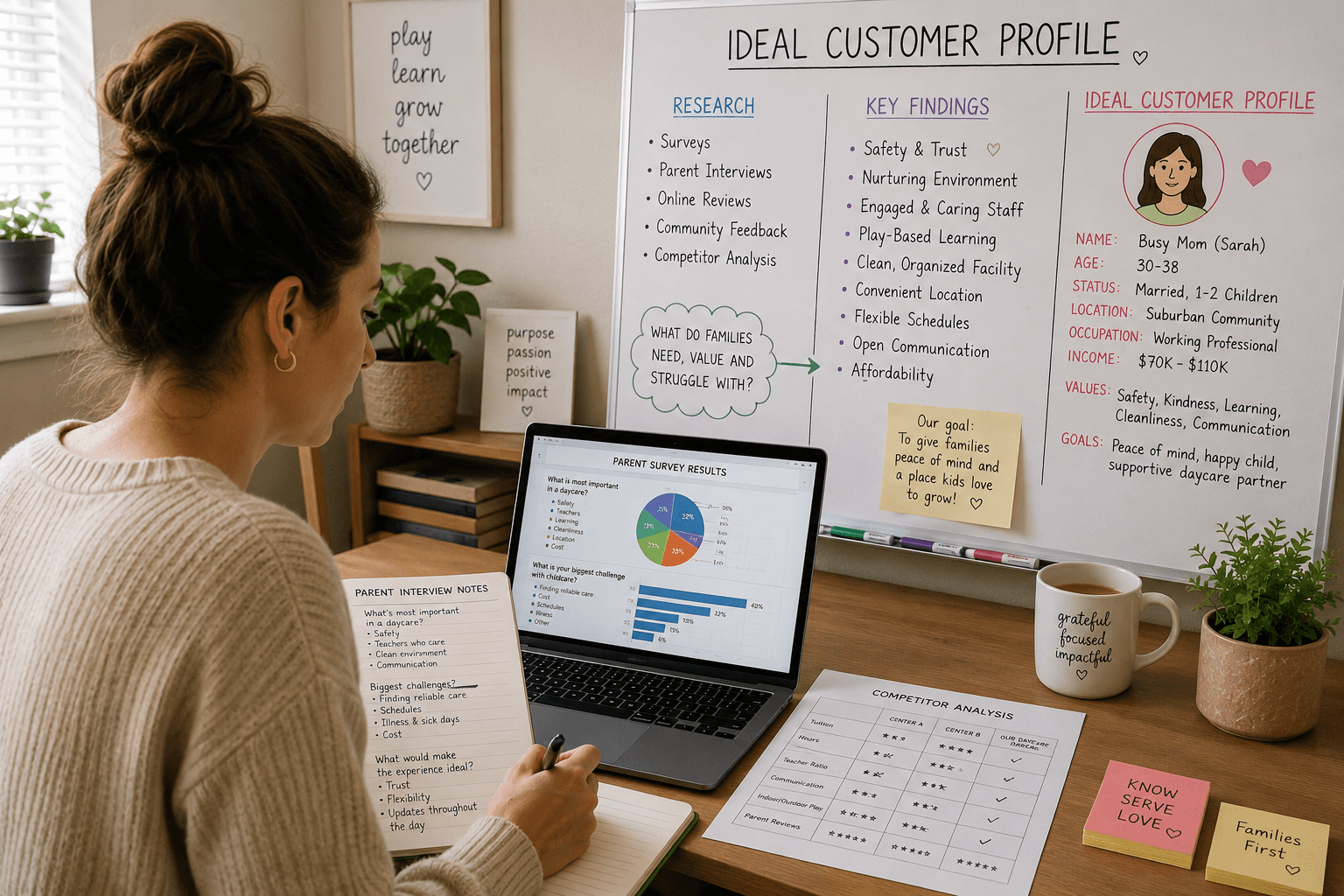
In today’s competitive child care market, parents face countless options, making generic marketing inefficient and expensive. An Ideal Customer Profile (ICP) allows daycare owners and child care providers to concentrate their efforts on the families who are the best match for their program: Those most likely to enroll, remain long-term, refer others, and experience genuine success with the services provided. A business owner who understands what an ICP is, why it is essential for childcare businesses, how to develop one, how to apply it effectively, and how to evaluate its impact has an inherent edge against their competitors.
Need help generating leads and turning them into loyal customers? Book a free demo with Playground to see how purpose-built solutions can grow your business.
What Is an Ideal Customer Profile?
An Ideal Customer Profile is a clear, research-backed description of the type of family that derives the greatest value from your daycare and represents the strongest long-term fit for your business. It outlines shared characteristics among this best fit, such as demographics, lifestyle, needs, behaviors, and values.
While a buyer persona is a detailed, narrative sketch of one imaginary parent (e.g., “Busy Working Mom Sarah”), an ICP functions as a broader strategic filter. It helps you decide precisely whom to target, serve, and prioritize. For a childcare center, the ICP defines the ideal family type most likely to choose your program, stay enrolled for years, and potentially expand their relationship by adding siblings or after-school care.
Why Develop an ICP for Your Daycare?
A thoughtfully crafted ICP provides powerful advantages that extend well beyond general marketing. It can transform how you attract, serve, and retain families while improving overall business decisions. Key benefits include:
More efficient marketing and lower costs: Advertising to everyone can result in wasted ad dollars. With a proper ICP, you can stop advertising to everyone and instead reach families who truly need and can afford your specific offerings.
Higher conversion rates: ICP-matched leads are quicker to tour, enroll, and commit.
Stronger retention and referrals: Families that fit well experience better alignment, resulting in longer stays, higher satisfaction, and enthusiastic word-of-mouth.
Better operational alignment: Programs, hours, staffing, and facilities can be designed around the real needs of your best customers.
Smarter business decisions: Use the ICP as a guiding filter when setting prices, choosing locations, creating new programs, or considering expansion.
Reduced wasted effort: You spend less time on mismatched prospects and lower churn caused by poor fit.
Playground can also help you increase retention and decrease churn. Find out more about how it can specifically help your business.
How to Pinpoint and Define Your ICP
Developing an ICP is a straightforward, research-based process that can begin simply and evolve as your center grows. Start by analyzing your current top-performing families. This might include those with the longest enrollments, lowest turnover, highest lifetime value, most referrals, and greatest overall satisfaction.
Identify the common traits that make these families ideal. Next, deepen your understanding by gathering data through parent surveys, interviews, local census information, and online research. Review working-parent statistics, income levels, competitor reviews, and parent forum discussions to uncover recurring needs and pain points. From this information, compile the most relevant characteristics.
Important categories typically include:
Demographics. Household income range, children’s ages, family size, parents’ work status, and proximity to your center.
Priorities. Your center or some families might cater to or prefer an emphasis on safety, early learning, qualified teachers, flexible scheduling, nurturing environments, or other specific approaches to care.
Behaviors and decision triggers. How they search for care, what prompts them to enroll (such as returning to work after maternity leave), and what they evaluate during the decision process.
Pain points: Challenges like unreliable previous care, scheduling conflicts, or concerns about child development and communication.
Once complete, summarize your ICP on a single, easy-to-reference page. This will be especially helpful for decision-making, especially as you grow your team and add staff members. Here is a practical example:
“Our ideal families are dual-income households with one or two children ages one to five, living within eight miles of our center. These parents are professionals earning $80,000–$140,000 annually and prioritize safety, play-based learning, strong teacher qualifications, flexible hours, and reliable daily communication. They are willing to invest in quality care for peace of mind and their child’s development.”
Begin with one primary ICP. You can add secondary profiles later as your business expands.
Looking for simple ways to help streamline and grow your business? See what Playground has to offer in a free demo call.
How to Use Your ICP in Daily Operations
The real power of an ICP emerges when you actively apply it across the business. Use it to guide:
Marketing efforts. Target ads on platforms like Facebook, Instagram, and Google to reach families matching the profile. Create content that directly addresses their challenges and highlights your unique strengths.
Enrollment process. Qualify inquiries against the ICP and tailor tours and follow-ups to emphasize the benefits most relevant to these families.
Program design. Align hours, curriculum, meals, enrichment activities, and parent communication tools with the needs and preferences of your ideal families.
Team alignment. Share the ICP with all staff so everyone understands the target families and can deliver consistent experiences.
Strategic decisions. Evaluate new ideas, pricing changes, or facility upgrades by asking whether they serve your ideal families.
How to Tell If Your ICP Is Working
You will know your ICP is effective when you observe consistent, positive changes in both numbers and feedback. Look for these important indicators that the strategy is working:
Higher lead-to-enrollment conversion rates, particularly from targeted channels
A growing percentage of new enrollments that naturally match your ICP criteria
Improved retention and reduced churn among ideal families
Lower customer acquisition costs and stronger marketing ROI
Faster fill rates for openings and more qualified families on waitlists
Smoother enrollment conversations and feedback that echoes the values in your profile
Review your ICP every six to twelve months – or after major changes such as relocation or new competition – using fresh data, parent input, and staff observations to keep it accurate.
Final Thoughts
Creating a strong Ideal Customer Profile is one of the highest-leverage steps you can take to build a thriving childcare business. It moves you from broad, reactive marketing to intentional, focused growth that attracts the right families and creates lasting value for everyone involved. Take time to review your best current families and draft a simple one-page ICP. As you refine and apply it, you will likely see clearer enrollment pipelines, stronger retention, and a deeper ability to make a positive difference in the lives of the children and families you serve best.
In today’s competitive child care market, parents face countless options, making generic marketing inefficient and expensive. An Ideal Customer Profile (ICP) allows daycare owners and child care providers to concentrate their efforts on the families who are the best match for their program: Those most likely to enroll, remain long-term, refer others, and experience genuine success with the services provided. A business owner who understands what an ICP is, why it is essential for childcare businesses, how to develop one, how to apply it effectively, and how to evaluate its impact has an inherent edge against their competitors.
Need help generating leads and turning them into loyal customers? Book a free demo with Playground to see how purpose-built solutions can grow your business.
What Is an Ideal Customer Profile?
An Ideal Customer Profile is a clear, research-backed description of the type of family that derives the greatest value from your daycare and represents the strongest long-term fit for your business. It outlines shared characteristics among this best fit, such as demographics, lifestyle, needs, behaviors, and values.
While a buyer persona is a detailed, narrative sketch of one imaginary parent (e.g., “Busy Working Mom Sarah”), an ICP functions as a broader strategic filter. It helps you decide precisely whom to target, serve, and prioritize. For a childcare center, the ICP defines the ideal family type most likely to choose your program, stay enrolled for years, and potentially expand their relationship by adding siblings or after-school care.
Why Develop an ICP for Your Daycare?
A thoughtfully crafted ICP provides powerful advantages that extend well beyond general marketing. It can transform how you attract, serve, and retain families while improving overall business decisions. Key benefits include:
More efficient marketing and lower costs: Advertising to everyone can result in wasted ad dollars. With a proper ICP, you can stop advertising to everyone and instead reach families who truly need and can afford your specific offerings.
Higher conversion rates: ICP-matched leads are quicker to tour, enroll, and commit.
Stronger retention and referrals: Families that fit well experience better alignment, resulting in longer stays, higher satisfaction, and enthusiastic word-of-mouth.
Better operational alignment: Programs, hours, staffing, and facilities can be designed around the real needs of your best customers.
Smarter business decisions: Use the ICP as a guiding filter when setting prices, choosing locations, creating new programs, or considering expansion.
Reduced wasted effort: You spend less time on mismatched prospects and lower churn caused by poor fit.
Playground can also help you increase retention and decrease churn. Find out more about how it can specifically help your business.
How to Pinpoint and Define Your ICP
Developing an ICP is a straightforward, research-based process that can begin simply and evolve as your center grows. Start by analyzing your current top-performing families. This might include those with the longest enrollments, lowest turnover, highest lifetime value, most referrals, and greatest overall satisfaction.
Identify the common traits that make these families ideal. Next, deepen your understanding by gathering data through parent surveys, interviews, local census information, and online research. Review working-parent statistics, income levels, competitor reviews, and parent forum discussions to uncover recurring needs and pain points. From this information, compile the most relevant characteristics.
Important categories typically include:
Demographics. Household income range, children’s ages, family size, parents’ work status, and proximity to your center.
Priorities. Your center or some families might cater to or prefer an emphasis on safety, early learning, qualified teachers, flexible scheduling, nurturing environments, or other specific approaches to care.
Behaviors and decision triggers. How they search for care, what prompts them to enroll (such as returning to work after maternity leave), and what they evaluate during the decision process.
Pain points: Challenges like unreliable previous care, scheduling conflicts, or concerns about child development and communication.
Once complete, summarize your ICP on a single, easy-to-reference page. This will be especially helpful for decision-making, especially as you grow your team and add staff members. Here is a practical example:
“Our ideal families are dual-income households with one or two children ages one to five, living within eight miles of our center. These parents are professionals earning $80,000–$140,000 annually and prioritize safety, play-based learning, strong teacher qualifications, flexible hours, and reliable daily communication. They are willing to invest in quality care for peace of mind and their child’s development.”
Begin with one primary ICP. You can add secondary profiles later as your business expands.
Looking for simple ways to help streamline and grow your business? See what Playground has to offer in a free demo call.
How to Use Your ICP in Daily Operations
The real power of an ICP emerges when you actively apply it across the business. Use it to guide:
Marketing efforts. Target ads on platforms like Facebook, Instagram, and Google to reach families matching the profile. Create content that directly addresses their challenges and highlights your unique strengths.
Enrollment process. Qualify inquiries against the ICP and tailor tours and follow-ups to emphasize the benefits most relevant to these families.
Program design. Align hours, curriculum, meals, enrichment activities, and parent communication tools with the needs and preferences of your ideal families.
Team alignment. Share the ICP with all staff so everyone understands the target families and can deliver consistent experiences.
Strategic decisions. Evaluate new ideas, pricing changes, or facility upgrades by asking whether they serve your ideal families.
How to Tell If Your ICP Is Working
You will know your ICP is effective when you observe consistent, positive changes in both numbers and feedback. Look for these important indicators that the strategy is working:
Higher lead-to-enrollment conversion rates, particularly from targeted channels
A growing percentage of new enrollments that naturally match your ICP criteria
Improved retention and reduced churn among ideal families
Lower customer acquisition costs and stronger marketing ROI
Faster fill rates for openings and more qualified families on waitlists
Smoother enrollment conversations and feedback that echoes the values in your profile
Review your ICP every six to twelve months – or after major changes such as relocation or new competition – using fresh data, parent input, and staff observations to keep it accurate.
Final Thoughts
Creating a strong Ideal Customer Profile is one of the highest-leverage steps you can take to build a thriving childcare business. It moves you from broad, reactive marketing to intentional, focused growth that attracts the right families and creates lasting value for everyone involved. Take time to review your best current families and draft a simple one-page ICP. As you refine and apply it, you will likely see clearer enrollment pipelines, stronger retention, and a deeper ability to make a positive difference in the lives of the children and families you serve best.
Jaclyn is a data journalist and CFP™ who evaluates trends in the childcare industry and wider economy. She has previously worked for publications including CNET, SmartAsset, Bizfluent, AZCentral and Chron, and as a research consultant for NAPCO Media. Her insights are often cited by publications including Bloomberg, CNBC, Business Insider, Fox News, USA Today, The Hill and more. She has a bachelor’s degree in economics and mathematics from The College of New Jersey.
Share this article



Book a demo and simplify every corner of your business.




Book a demo and simplify every corner of your business.
