

Child Care & ECE Policy Roundup: Key Changes by State, July 2026
Child Care & ECE Policy Roundup: Key Changes by State, July 2026
Child Care & ECE Policy Roundup: Key Changes by State, July 2026

Last updated:
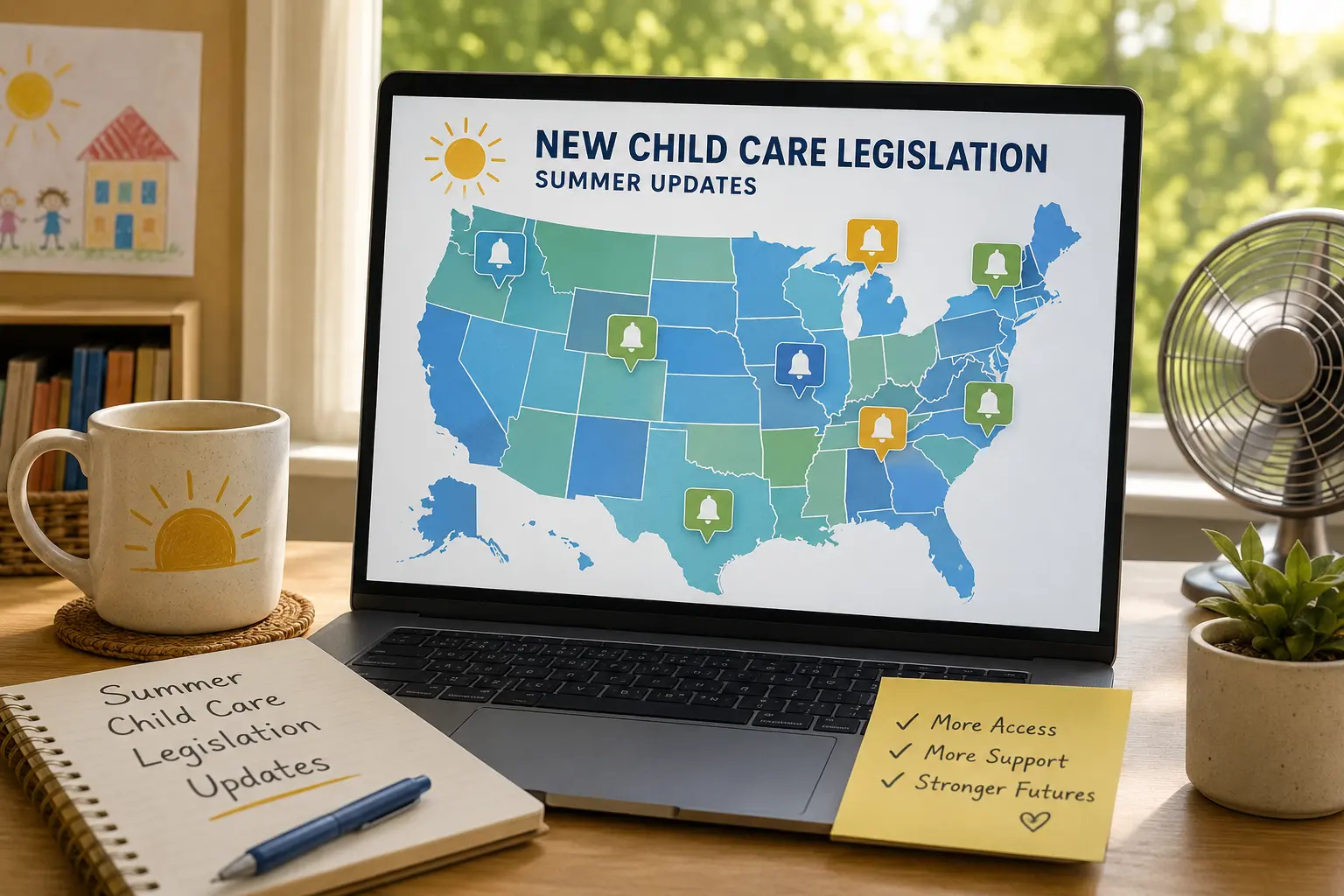
With most U.S. states kicking off their new fiscal year on July 1, this is prime time for child care and early childhood policy shifts. From eligibility expansions and rate adjustments to structural reforms and funding cliffs, states are balancing budgets, workforce needs, and family access amid rising costs and evolving federal rules. Here’s a quick roundup of the most notable developments taking effect or advancing right now in:
Nebraska
Washington
Oklahoma
Virginia
California
Illinois
Wisconsin
Learn how Playground can help keep your center organized and compliant despite rolling legislative changes. Book a free demo here.
Nebraska: Permanent expansion of eligibility
Governor Jim Pillen ceremonially signed on June 16, 2026, making higher income eligibility limits for the state’s child care subsidy program permanent.
On June 16, 2026, Governor Jim Pillen ceremonially signed LB 304 into law, permanently locking in higher income eligibility for the state’s child care subsidy program at 185% of the Federal Poverty Level (about $61,050 a year for a family of four). This eliminates the sunset on the temporary pandemic-era expansion (previously set to drop back to ~130% FPL after October 1), keeping child care assistance available to thousands of working and middle-income families who would have otherwise lost it. The bipartisan measure, prioritized by Sen. Wendy DeBoer, has already helped over 4,800 families and costs about $4.2 million annually.
Washington: Rate updates and stabilized (non-expanding) eligibility
In Washington state, Governor Bob Ferguson signed SHB 2689 into law on April 1st, making targeted adjustments to the Working Connections Child Care (WCCC) subsidy program amid budget pressures, effective July 1st. The bill halts planned eligibility expansions, keeping income limits at 60% of State Median Income instead of rising to 75% and later 85%. It updates center reimbursement rates to the 85th percentile of the most recent market rate survey (with regional tweaks, such as Clark County aligning to Region 6 rates), while shifting some payment policies toward attendance-based reimbursements to achieve cost savings. These changes provide modest rate relief for providers in key areas while pausing broader expansions and managing caseload growth.
Oklahoma: Return to pre-pandemic eligibility threshold
Effective July 1, 2026, Oklahoma’s child care subsidy program will return income eligibility to 55% of State Median Income (SMI), aligning with pre-pandemic guidelines and federal CCDF priorities. This change, announced by the Oklahoma Department of Human Services, rolls back temporary higher eligibility thresholds used during the pandemic recovery period. The adjustment aims to prioritize families most in need while maintaining program stability. Families and providers have been given advance notice to plan accordingly.
Virginia: Additional slots and incentives
As part of Virginia’s 2026–2028 biennial budget (effective July 1, 2026 for FY2027), lawmakers redirected non-participation savings from the Virginia Preschool Initiative to the Child Care Subsidy Program. This is expected to create roughly 6,745 additional slots for eligible children, with a strong emphasis on birth-to-five care. The budget also includes one-time $1 million in matching funds to encourage employer contributions toward employee child care costs. While this expands access, some localities may still maintain waitlists when demand exceeds funded slots.
California: No new slots + COLA adjustments for rate stabilization
California’s 2026-27 state budget (enacted June 2026, with provisions effective July 1, 2026) reflects tight fiscal realities, resulting in no new funding for previously planned expansions of subsidized child care slots (tens of thousands delayed from the multi-year commitment made in 2021-22). The budget suspends or adjusts the statutory cost-of-living adjustment (COLA) for reimbursement rates in some programs while redirecting savings to “cost-of-care plus” payments; starting July 1, 2026, a new minimum annual rate increase equivalent to the statutory COLA is required for all subsidized providers. This approach prioritizes rate stabilization over slot growth amid budget constraints.
Illinois launches its new Department of Early Childhood (IDEC) on July 1, 2026
Effective July 1, 2026, Illinois officially launches its new Department of Early Childhood (IDEC), the first cabinet-level department of its kind in the state. This consolidates early childhood programs – including child care licensing and assistance (CCAP), Head Start collaboration, home visiting, quality initiatives, and more – from the Illinois Department of Human Services and other agencies into one dedicated entity. Governor Pritzker appointed Dr. Teresa Ramos as the inaugural Secretary. The goal is to streamline coordination, improve access and equity for families (especially ages 0 - 5), and better support providers amid ongoing workforce and affordability challenges. This is primarily a structural/administrative shift rather than a direct rate or eligibility change.
Wisconsin’s temporary Child Care Bridge Payments (and related stabilization funding) ends on June 30, 2026
Wisconsin’s temporary Child Care Bridge Payments program – which provided monthly direct stipends to thousands of child care providers to stabilize operations after federal pandemic-era funds expired – officially ends on June 30, 2026. The $110 million initiative (part of the 2025–27 state budget) offered financial support based on enrollment and staffing. Its conclusion has raised concerns among providers about potential closures (reports suggest up to 25% could be at risk), reduced capacity, staffing shortages, or tuition increases for families. No permanent replacement funding has been enacted yet, though advocates are pushing for solutions. Providers and families should monitor local options and DCF updates for impacts on 0–5 care.
The bottom line
As states navigate post-pandemic funding cliffs, rising costs, and workforce shortages, Summer 2026 marks a mix of stabilization wins, tough trade-offs, and structural reforms in early childhood care. While expansions like Nebraska’s permanent eligibility boost and Virginia’s new slots offer relief, endings like Wisconsin’s Bridge Payments and paused growth in places like California highlight ongoing sustainability challenges. Providers and families should check state agencies (e.g., DCF, DHS, ECECD) for the latest eligibility, rates, and waitlist status, as many programs remain demand-driven. Expect more movement in the fall as legislatures reconvene and federal CCDF rules continue to evolve.
With most U.S. states kicking off their new fiscal year on July 1, this is prime time for child care and early childhood policy shifts. From eligibility expansions and rate adjustments to structural reforms and funding cliffs, states are balancing budgets, workforce needs, and family access amid rising costs and evolving federal rules. Here’s a quick roundup of the most notable developments taking effect or advancing right now in:
Nebraska
Washington
Oklahoma
Virginia
California
Illinois
Wisconsin
Learn how Playground can help keep your center organized and compliant despite rolling legislative changes. Book a free demo here.
Nebraska: Permanent expansion of eligibility
Governor Jim Pillen ceremonially signed on June 16, 2026, making higher income eligibility limits for the state’s child care subsidy program permanent.
On June 16, 2026, Governor Jim Pillen ceremonially signed LB 304 into law, permanently locking in higher income eligibility for the state’s child care subsidy program at 185% of the Federal Poverty Level (about $61,050 a year for a family of four). This eliminates the sunset on the temporary pandemic-era expansion (previously set to drop back to ~130% FPL after October 1), keeping child care assistance available to thousands of working and middle-income families who would have otherwise lost it. The bipartisan measure, prioritized by Sen. Wendy DeBoer, has already helped over 4,800 families and costs about $4.2 million annually.
Washington: Rate updates and stabilized (non-expanding) eligibility
In Washington state, Governor Bob Ferguson signed SHB 2689 into law on April 1st, making targeted adjustments to the Working Connections Child Care (WCCC) subsidy program amid budget pressures, effective July 1st. The bill halts planned eligibility expansions, keeping income limits at 60% of State Median Income instead of rising to 75% and later 85%. It updates center reimbursement rates to the 85th percentile of the most recent market rate survey (with regional tweaks, such as Clark County aligning to Region 6 rates), while shifting some payment policies toward attendance-based reimbursements to achieve cost savings. These changes provide modest rate relief for providers in key areas while pausing broader expansions and managing caseload growth.
Oklahoma: Return to pre-pandemic eligibility threshold
Effective July 1, 2026, Oklahoma’s child care subsidy program will return income eligibility to 55% of State Median Income (SMI), aligning with pre-pandemic guidelines and federal CCDF priorities. This change, announced by the Oklahoma Department of Human Services, rolls back temporary higher eligibility thresholds used during the pandemic recovery period. The adjustment aims to prioritize families most in need while maintaining program stability. Families and providers have been given advance notice to plan accordingly.
Virginia: Additional slots and incentives
As part of Virginia’s 2026–2028 biennial budget (effective July 1, 2026 for FY2027), lawmakers redirected non-participation savings from the Virginia Preschool Initiative to the Child Care Subsidy Program. This is expected to create roughly 6,745 additional slots for eligible children, with a strong emphasis on birth-to-five care. The budget also includes one-time $1 million in matching funds to encourage employer contributions toward employee child care costs. While this expands access, some localities may still maintain waitlists when demand exceeds funded slots.
California: No new slots + COLA adjustments for rate stabilization
California’s 2026-27 state budget (enacted June 2026, with provisions effective July 1, 2026) reflects tight fiscal realities, resulting in no new funding for previously planned expansions of subsidized child care slots (tens of thousands delayed from the multi-year commitment made in 2021-22). The budget suspends or adjusts the statutory cost-of-living adjustment (COLA) for reimbursement rates in some programs while redirecting savings to “cost-of-care plus” payments; starting July 1, 2026, a new minimum annual rate increase equivalent to the statutory COLA is required for all subsidized providers. This approach prioritizes rate stabilization over slot growth amid budget constraints.
Illinois launches its new Department of Early Childhood (IDEC) on July 1, 2026
Effective July 1, 2026, Illinois officially launches its new Department of Early Childhood (IDEC), the first cabinet-level department of its kind in the state. This consolidates early childhood programs – including child care licensing and assistance (CCAP), Head Start collaboration, home visiting, quality initiatives, and more – from the Illinois Department of Human Services and other agencies into one dedicated entity. Governor Pritzker appointed Dr. Teresa Ramos as the inaugural Secretary. The goal is to streamline coordination, improve access and equity for families (especially ages 0 - 5), and better support providers amid ongoing workforce and affordability challenges. This is primarily a structural/administrative shift rather than a direct rate or eligibility change.
Wisconsin’s temporary Child Care Bridge Payments (and related stabilization funding) ends on June 30, 2026
Wisconsin’s temporary Child Care Bridge Payments program – which provided monthly direct stipends to thousands of child care providers to stabilize operations after federal pandemic-era funds expired – officially ends on June 30, 2026. The $110 million initiative (part of the 2025–27 state budget) offered financial support based on enrollment and staffing. Its conclusion has raised concerns among providers about potential closures (reports suggest up to 25% could be at risk), reduced capacity, staffing shortages, or tuition increases for families. No permanent replacement funding has been enacted yet, though advocates are pushing for solutions. Providers and families should monitor local options and DCF updates for impacts on 0–5 care.
The bottom line
As states navigate post-pandemic funding cliffs, rising costs, and workforce shortages, Summer 2026 marks a mix of stabilization wins, tough trade-offs, and structural reforms in early childhood care. While expansions like Nebraska’s permanent eligibility boost and Virginia’s new slots offer relief, endings like Wisconsin’s Bridge Payments and paused growth in places like California highlight ongoing sustainability challenges. Providers and families should check state agencies (e.g., DCF, DHS, ECECD) for the latest eligibility, rates, and waitlist status, as many programs remain demand-driven. Expect more movement in the fall as legislatures reconvene and federal CCDF rules continue to evolve.
Jaclyn is a data journalist and CFP™ who evaluates trends in the childcare industry and wider economy. She has previously worked for publications including CNET, SmartAsset, Bizfluent, AZCentral and Chron, and as a research consultant for NAPCO Media. Her insights are often cited by publications including Bloomberg, CNBC, Business Insider, Fox News, USA Today, The Hill and more. She has a bachelor’s degree in economics and mathematics from The College of New Jersey.
Share this article
The highest rated child care software
Ratings and review counts from public app store listings, May 2026.




Book a demo and simplify every corner of your business.




Book a demo and simplify every corner of your business.
