


State-Funded Pre-K Professional Development Requirements for Teachers
8 min read
Aug 27, 2026
Staff
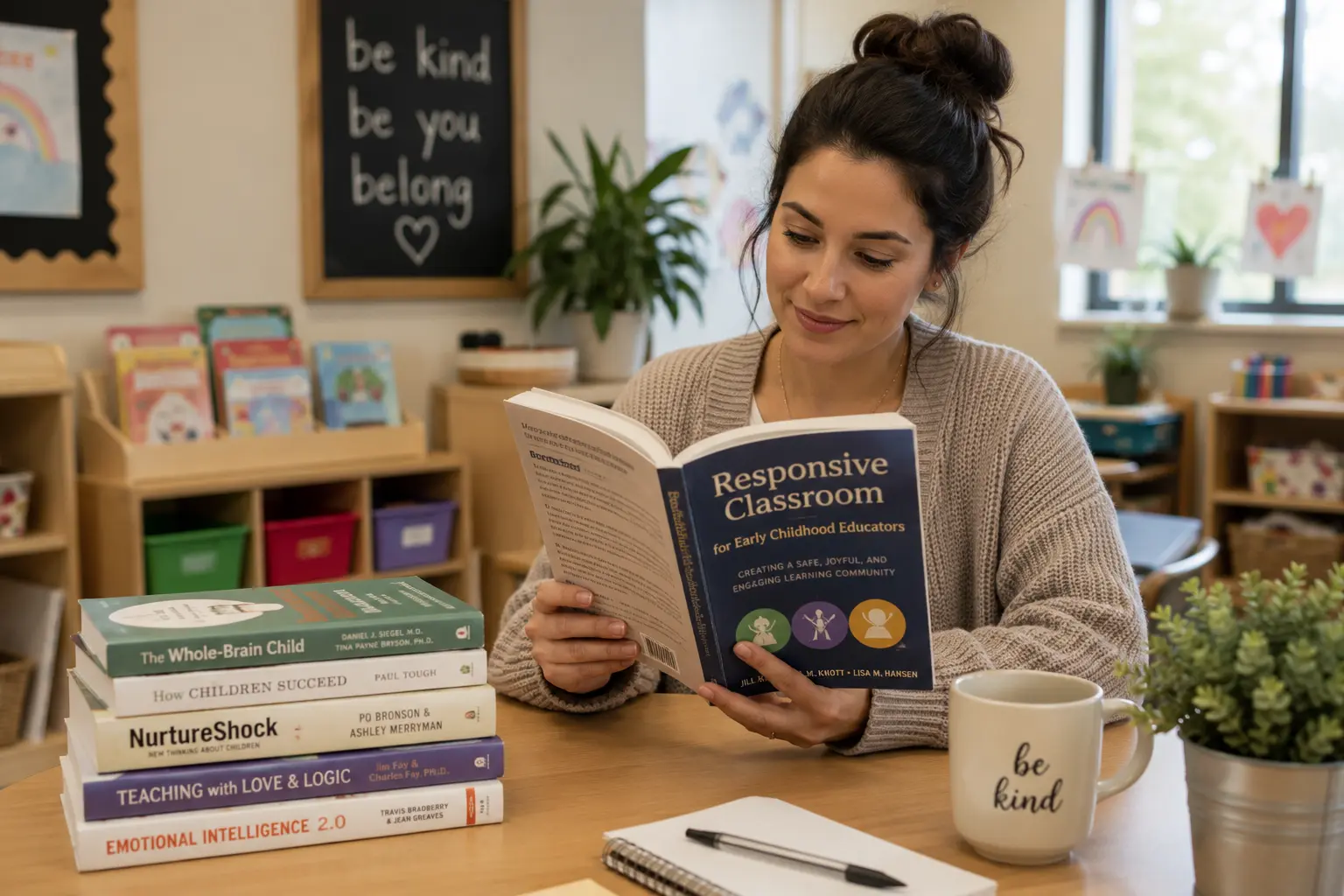
Becoming a better early childhood teacher or director through self-enrichment is one of the most reliable ways to boost team morale, improve children’s behavior and development, and strengthen the business itself. Better practice at every level feeds a healthier program and, ultimately, a healthier business. This list brings together foundational works that created entire branches of early childhood education – Montessori and Reggio Emilia – alongside newer publications worth serious consideration. Together they offer a well-rounded mix of scientifically grounded insight, lived experience from industry veterans, and practical attention to children, families, staff, and the wider field.
For longtime professionals, these books can feel like a conversation with someone who has walked similar halls. For those just starting out, they offer a way to close experiential gaps. Each entry includes a short note on the book and one small action derived from the subject matter that you can try this week.
Looking for ways to digitize and streamline your operations so you can focus more on what matters? Consider booking a free demo with Playground.
The Absorbent Mind
Author: Maria Montessori
Topic area: Child development
While The Montessori Method is the more foundational text, The Absorbent Mind was written later, after Montessori had refined her thinking through decades of observation. Many readers find it more accessible and digestible. Other key works include The Montessori Method, The Secret of Childhood, Dr. Montessori’s Own Handbook, The Child in the Family, and To Educate the Human Potential.
Try this week: Choose one everyday material or activity, show it briefly, then step back completely and observe what the child does and discovers without any verbal guidance or correction from you.
How We Learn
Author: Stanislas Dehaene
Topic area: Child development
This book supplies the scientific basis for how children learn, moving beyond purely psychological or behavioral explanations into biology and neuroscience. It clarifies why attention, active engagement, error feedback, and sleep are so powerful, and why babies and young children are already sophisticated learners. The same principles also shed light on how artificial intelligence learns, which may be useful as AI expands its reach among education tools.
Try this week: When a child makes a “mistake,” pause and treat it as information the brain is actively using rather than something to correct immediately.
The Hundred Languages of Children
Author: Carolyn Edwards, Lella Gandini, and George Forman
Topic area: Classroom
One of the central texts of the Reggio Emilia approach. It explores the many ways children express and construct knowledge – far beyond spoken language – and has appeared in several editions over the years.
Try this week: After a shared experience, offer children two different “languages” (for example, drawing and clay, or movement and storytelling) to express what they noticed.
The Intentional Teacher: Choosing the Best Strategies for Young Children’s Learning
Author: Ann S. Epstein
Topic area: Classroom
A clear guide to moving fluidly between child-guided and adult-guided experiences so that children both explore and acquire important knowledge and skills.
Try this week: In one learning area, decide in advance which parts will be mostly child-guided and where you will intentionally step in with a question or new material.
Families and Educators Together: Building Great Relationships that Support Young Children
Authors: Derry Koralek, Karen Nemeth and Kelly Ramsey (NAEYC, 2019)
Topic area: Family
A practical resource for creating a culture of reciprocal family engagement by building welcoming environments, two-way communication, support for diverse languages and cultures, and genuine collaboration around children’s learning.
Try this week: Ask one family a genuine open-ended question about what their child loves to do at home, then bring one element of that into the classroom the next day.
From Survive to Thrive: A Director’s Guide for Leading an Early Childhood Program
Authors: Debbie LeeKeenan and Iris Chin Ponte
Topic area: Business
Written for directors who want to lead a comprehensive, high-quality program. Covers the full range of responsibilities from staffing and budgets to family partnerships and enrollment.
Try this week: Choose one recurring operational headache and write down the current process in three clear steps – then ask a trusted staff member where it breaks down.
Handbook for Early Childhood Administrators: Directing with a Mission
Authors: Hilde Reno, Janet Stutzman, Judy Zimmerman
Topic area: Business
Practical guidance plus concrete tools such as forms, job descriptions and systems that help a teacher or civilian step into a leadership role. Some regulatory details and forms may be dated (the book is roughly fifteen years old), so pair it with current resources for the latest compliance needs (Playground offers up to date and customizable forms in the app, if you need). Otherwise, the underlying principles and examples of mission-driven administration still hold.
Try this week: Draft or revise one simple one-page job expectation sheet for a key role, focusing on the mission of the program rather than a long task list.
Handbook of Early Childhood Education
Contributors: W. Steven Barnett, Robert C. Pianta, Laura M. Justice, Susan M. Sheridan
Topic area: Industry
Useful for understanding the economics of early childhood education and its place in the broader economy. Helps directors and advocates interpret legislative developments, pricing, marketing, and larger contextual forces shaping the field.
Try this week: Look up one recent piece of local or national ECE policy news and ask: “How does this affect the economics of programs like mine?”
Culturally Responsive Self-Care Practices for Early Childhood Educators
Authors: Julie Nicholson, Priya Driscoll, Julie Kurtz, Doménica Márquez, LaWanda Wesley
Topic area: Self / teachers
This book draws from a wide range of roles, cultural perspectives, and program types. It is especially helpful for directors seeking to support a diverse staff, because it explicitly asserts that self-care for teachers is not one-size-fits-all.
Try this week: Identify one small recovery practice that actually fits your culture, schedule, and personality – and protect ten minutes for it three times this week.
Overcoming Teacher Burnout in Early Childhood: Strategies for Change
Author: Ellen M. Drolette
Topic area: Self / teachers
Valuable both for individual educators and for directors who want to improve retention. A thriving staff improves child outcomes and the financial health of the program.
Try this week: Name one specific drain on your energy this week and one boundary or support you can put in place to reduce it.
These books will not transform a program overnight. Read with a critical eye, test the ideas in your own setting, and keep what works. The principles that have lasted – deep respect for the child, intentional adult roles, strong relationships with families, and sustainable leadership – remain as relevant as ever.
For more interactive enrichment, check out Playground’s rankings for the best professional development courses for early childhood educators, or book a personal demo to learn how Playground can help your team.
Becoming a better early childhood teacher or director through self-enrichment is one of the most reliable ways to boost team morale, improve children’s behavior and development, and strengthen the business itself. Better practice at every level feeds a healthier program and, ultimately, a healthier business. This list brings together foundational works that created entire branches of early childhood education – Montessori and Reggio Emilia – alongside newer publications worth serious consideration. Together they offer a well-rounded mix of scientifically grounded insight, lived experience from industry veterans, and practical attention to children, families, staff, and the wider field.
For longtime professionals, these books can feel like a conversation with someone who has walked similar halls. For those just starting out, they offer a way to close experiential gaps. Each entry includes a short note on the book and one small action derived from the subject matter that you can try this week.
Looking for ways to digitize and streamline your operations so you can focus more on what matters? Consider booking a free demo with Playground.
The Absorbent Mind
Author: Maria Montessori
Topic area: Child development
While The Montessori Method is the more foundational text, The Absorbent Mind was written later, after Montessori had refined her thinking through decades of observation. Many readers find it more accessible and digestible. Other key works include The Montessori Method, The Secret of Childhood, Dr. Montessori’s Own Handbook, The Child in the Family, and To Educate the Human Potential.
Try this week: Choose one everyday material or activity, show it briefly, then step back completely and observe what the child does and discovers without any verbal guidance or correction from you.
How We Learn
Author: Stanislas Dehaene
Topic area: Child development
This book supplies the scientific basis for how children learn, moving beyond purely psychological or behavioral explanations into biology and neuroscience. It clarifies why attention, active engagement, error feedback, and sleep are so powerful, and why babies and young children are already sophisticated learners. The same principles also shed light on how artificial intelligence learns, which may be useful as AI expands its reach among education tools.
Try this week: When a child makes a “mistake,” pause and treat it as information the brain is actively using rather than something to correct immediately.
The Hundred Languages of Children
Author: Carolyn Edwards, Lella Gandini, and George Forman
Topic area: Classroom
One of the central texts of the Reggio Emilia approach. It explores the many ways children express and construct knowledge – far beyond spoken language – and has appeared in several editions over the years.
Try this week: After a shared experience, offer children two different “languages” (for example, drawing and clay, or movement and storytelling) to express what they noticed.
The Intentional Teacher: Choosing the Best Strategies for Young Children’s Learning
Author: Ann S. Epstein
Topic area: Classroom
A clear guide to moving fluidly between child-guided and adult-guided experiences so that children both explore and acquire important knowledge and skills.
Try this week: In one learning area, decide in advance which parts will be mostly child-guided and where you will intentionally step in with a question or new material.
Families and Educators Together: Building Great Relationships that Support Young Children
Authors: Derry Koralek, Karen Nemeth and Kelly Ramsey (NAEYC, 2019)
Topic area: Family
A practical resource for creating a culture of reciprocal family engagement by building welcoming environments, two-way communication, support for diverse languages and cultures, and genuine collaboration around children’s learning.
Try this week: Ask one family a genuine open-ended question about what their child loves to do at home, then bring one element of that into the classroom the next day.
From Survive to Thrive: A Director’s Guide for Leading an Early Childhood Program
Authors: Debbie LeeKeenan and Iris Chin Ponte
Topic area: Business
Written for directors who want to lead a comprehensive, high-quality program. Covers the full range of responsibilities from staffing and budgets to family partnerships and enrollment.
Try this week: Choose one recurring operational headache and write down the current process in three clear steps – then ask a trusted staff member where it breaks down.
Handbook for Early Childhood Administrators: Directing with a Mission
Authors: Hilde Reno, Janet Stutzman, Judy Zimmerman
Topic area: Business
Practical guidance plus concrete tools such as forms, job descriptions and systems that help a teacher or civilian step into a leadership role. Some regulatory details and forms may be dated (the book is roughly fifteen years old), so pair it with current resources for the latest compliance needs (Playground offers up to date and customizable forms in the app, if you need). Otherwise, the underlying principles and examples of mission-driven administration still hold.
Try this week: Draft or revise one simple one-page job expectation sheet for a key role, focusing on the mission of the program rather than a long task list.
Handbook of Early Childhood Education
Contributors: W. Steven Barnett, Robert C. Pianta, Laura M. Justice, Susan M. Sheridan
Topic area: Industry
Useful for understanding the economics of early childhood education and its place in the broader economy. Helps directors and advocates interpret legislative developments, pricing, marketing, and larger contextual forces shaping the field.
Try this week: Look up one recent piece of local or national ECE policy news and ask: “How does this affect the economics of programs like mine?”
Culturally Responsive Self-Care Practices for Early Childhood Educators
Authors: Julie Nicholson, Priya Driscoll, Julie Kurtz, Doménica Márquez, LaWanda Wesley
Topic area: Self / teachers
This book draws from a wide range of roles, cultural perspectives, and program types. It is especially helpful for directors seeking to support a diverse staff, because it explicitly asserts that self-care for teachers is not one-size-fits-all.
Try this week: Identify one small recovery practice that actually fits your culture, schedule, and personality – and protect ten minutes for it three times this week.
Overcoming Teacher Burnout in Early Childhood: Strategies for Change
Author: Ellen M. Drolette
Topic area: Self / teachers
Valuable both for individual educators and for directors who want to improve retention. A thriving staff improves child outcomes and the financial health of the program.
Try this week: Name one specific drain on your energy this week and one boundary or support you can put in place to reduce it.
These books will not transform a program overnight. Read with a critical eye, test the ideas in your own setting, and keep what works. The principles that have lasted – deep respect for the child, intentional adult roles, strong relationships with families, and sustainable leadership – remain as relevant as ever.
For more interactive enrichment, check out Playground’s rankings for the best professional development courses for early childhood educators, or book a personal demo to learn how Playground can help your team.
Are Montessori and Reggio Emilia books still relevant for modern early childhood programs?
What should new early childhood teachers read first?
How do I choose professional development books for my early childhood team?
Where should child care directors start if they want to improve their leadership skills?

Jaclyn DeJohn, CFP®
Director of Content
Jaclyn is a data journalist and CFP™ who evaluates trends in the childcare industry and wider economy. She has previously worked for publications including CNET, SmartAsset, Bizfluent, AZCentral and Chron, and as a research consultant for NAPCO Media. Her insights are often cited by publications including Bloomberg, CNBC, Business Insider, Fox News, USA Today, The Hill and more. She has a bachelor’s degree in economics and mathematics from The College of New Jersey.
Date created

Nick Caughell
The Weston School
of directors say Playground saves them hours every week
Based on data from 5,000+ centers.




State-Funded Pre-K Professional Development Requirements for Teachers
8 min read
Aug 27, 2026
Staff

The Complete CDA Credential Breakdown: Requirements, Salary & Retention Impact
7 min read
Aug 25, 2026
Staff
Upcoming Early Childhood Education Conferences and Events for Late 2026
5 min read
Aug 24, 2026
Staff
