

Virginia’s Employee Child Care Assistance Program: Governor Spanberger’s Signs HB 18 / SB 3 Into Law
Virginia’s Employee Child Care Assistance Program: Governor Spanberger’s Signs HB 18 / SB 3 Into Law
Virginia’s Employee Child Care Assistance Program: Governor Spanberger’s Signs HB 18 / SB 3 Into Law

Last updated:
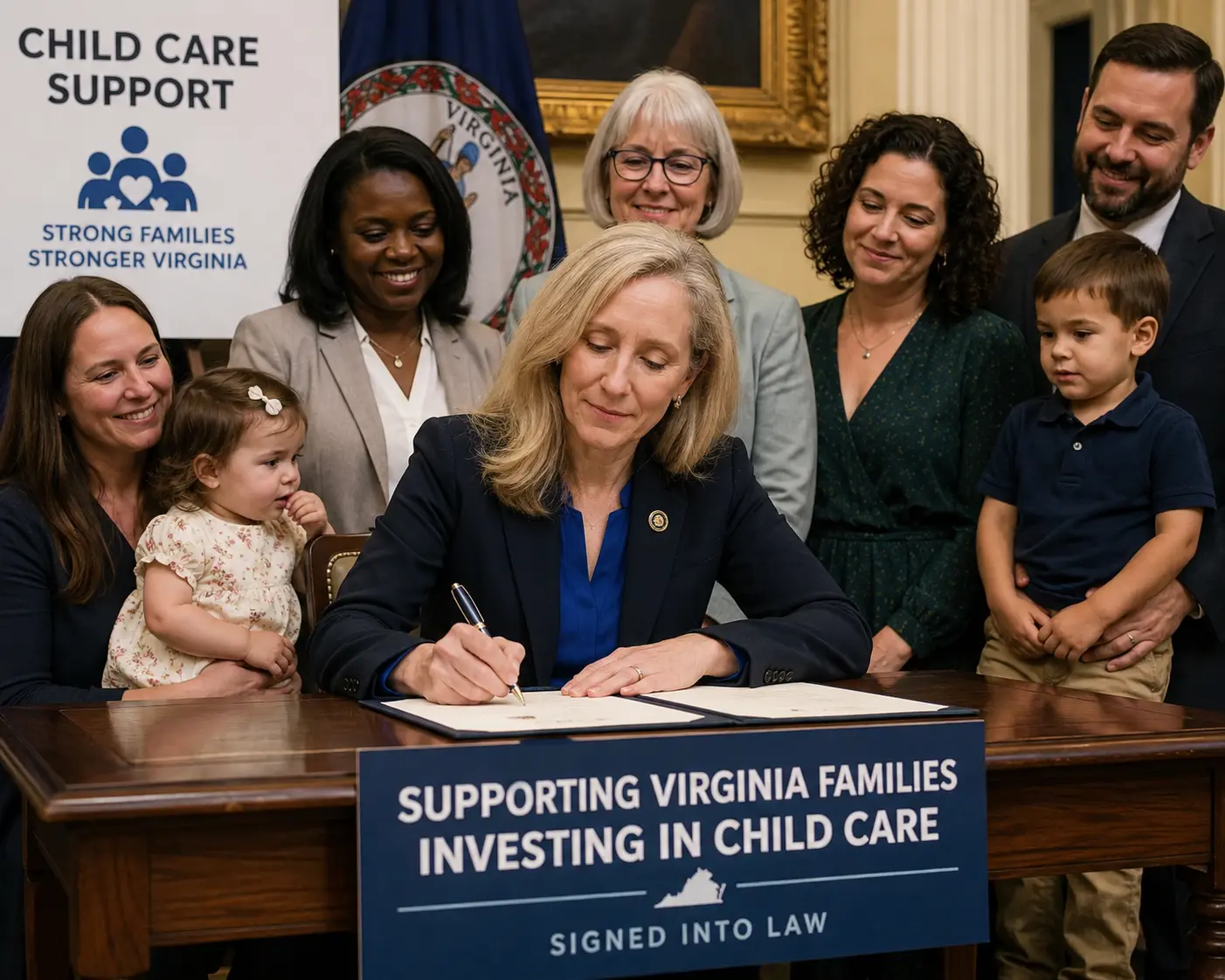
In late May 2026, Virginia Governor Abigail Spanberger signed a package of bipartisan bills designed to help the child care industry via lower costs for families, increased employer engagement, refined data practices to ensure funding stability, and strengthened early childhood programs.
These bills include the Employee Child Care Assistance Program (HB 18 / SB 3), improved cost calculation legislation (HB 1208 / SB 134), and Head Start strengthening measures (HB 211). These developments in Virginia legislation mirror similar programs in Kentucky, Michigan and North Dakota. While these developments aren’t generally contributing funds direct to child care businesses, supplementing funds for parents helps increase demand for services.
The Employee Child Care Assistance Program (HB 18 / SB 3)
At the heart of the new legislation is the Employee Child Care Assistance Program (HB 18 / SB 3). This initiative creates a state matching fund that supports employers who contribute toward their workers’ child care expenses. Employers can direct contributions to eligible mixed-delivery providers or use a third-party administrator.
The Virginia Early Childhood Foundation oversees the program, prioritizing applications from smaller businesses (typically 50 or fewer employees) on a first-come, first-serve basis. This potentially allows child care directors to more easily fill enrollment slots, while reducing out-of-pocket costs for families, potentially improving enrollment stability and supporting staff recruitment and retention efforts. The program also includes built-in accountability, with an interim report due by September 1, 2028, and a final evaluation in 2030 to measure its effectiveness.
Additional key reforms
Governor Spanberger also signed two supporting bills that address systemic issues many directors face in Virginia:
HB 1208 / SB 134 requires the Department of Education to produce accurate, annual calculations of early childhood care and education costs and requirements. The methodology incorporates quality rates, actual prior-year spending, parental demand trends, and economic development priorities, with special attention to child care deserts. The goal is to reduce funding volatility and long waitlists that create uncertainty for providers.
HB 211 directs a comprehensive review of Head Start and Early Head Start programs to identify ways to strengthen these critical services.
These bills were signed in a ceremonial event in Richmond that brought together parents, educators, business leaders, and state officials, underscoring broad support for collaborative solutions.
Why these Virginia developments matter to all child care directors
Virginia’s approach demonstrates how states can create public-private partnerships that ease financial pressure on families without placing the entire burden on providers or government budgets. Employer engagement, in particular, represents a promising strategy for stabilizing revenue and filling seats with families who might otherwise struggle to afford care.
The emphasis on better data collection is equally significant. Inconsistent or outdated funding formulas plague many states and subsidy programs, leading to unpredictable reimbursements and operational headaches. Virginia’s requirement for transparent, annually updated cost calculations gives directors a stronger foundation for advocacy when pushing for rate adjustments or expanded support in their own states. Additionally, the bipartisan nature of these bills highlights that child care solutions can gain traction across political lines when framed as economic development tools. With parents still facing high costs and providers grappling with staffing shortages, this framing can help directors engage local chambers of commerce, legislators, and economic development offices more effectively.
Looking for ways to grow and market your business independent of new legislation? Try booking a demo with Playground to see how purpose-built software solutions for child care can help you grow.
In late May 2026, Virginia Governor Abigail Spanberger signed a package of bipartisan bills designed to help the child care industry via lower costs for families, increased employer engagement, refined data practices to ensure funding stability, and strengthened early childhood programs.
These bills include the Employee Child Care Assistance Program (HB 18 / SB 3), improved cost calculation legislation (HB 1208 / SB 134), and Head Start strengthening measures (HB 211). These developments in Virginia legislation mirror similar programs in Kentucky, Michigan and North Dakota. While these developments aren’t generally contributing funds direct to child care businesses, supplementing funds for parents helps increase demand for services.
The Employee Child Care Assistance Program (HB 18 / SB 3)
At the heart of the new legislation is the Employee Child Care Assistance Program (HB 18 / SB 3). This initiative creates a state matching fund that supports employers who contribute toward their workers’ child care expenses. Employers can direct contributions to eligible mixed-delivery providers or use a third-party administrator.
The Virginia Early Childhood Foundation oversees the program, prioritizing applications from smaller businesses (typically 50 or fewer employees) on a first-come, first-serve basis. This potentially allows child care directors to more easily fill enrollment slots, while reducing out-of-pocket costs for families, potentially improving enrollment stability and supporting staff recruitment and retention efforts. The program also includes built-in accountability, with an interim report due by September 1, 2028, and a final evaluation in 2030 to measure its effectiveness.
Additional key reforms
Governor Spanberger also signed two supporting bills that address systemic issues many directors face in Virginia:
HB 1208 / SB 134 requires the Department of Education to produce accurate, annual calculations of early childhood care and education costs and requirements. The methodology incorporates quality rates, actual prior-year spending, parental demand trends, and economic development priorities, with special attention to child care deserts. The goal is to reduce funding volatility and long waitlists that create uncertainty for providers.
HB 211 directs a comprehensive review of Head Start and Early Head Start programs to identify ways to strengthen these critical services.
These bills were signed in a ceremonial event in Richmond that brought together parents, educators, business leaders, and state officials, underscoring broad support for collaborative solutions.
Why these Virginia developments matter to all child care directors
Virginia’s approach demonstrates how states can create public-private partnerships that ease financial pressure on families without placing the entire burden on providers or government budgets. Employer engagement, in particular, represents a promising strategy for stabilizing revenue and filling seats with families who might otherwise struggle to afford care.
The emphasis on better data collection is equally significant. Inconsistent or outdated funding formulas plague many states and subsidy programs, leading to unpredictable reimbursements and operational headaches. Virginia’s requirement for transparent, annually updated cost calculations gives directors a stronger foundation for advocacy when pushing for rate adjustments or expanded support in their own states. Additionally, the bipartisan nature of these bills highlights that child care solutions can gain traction across political lines when framed as economic development tools. With parents still facing high costs and providers grappling with staffing shortages, this framing can help directors engage local chambers of commerce, legislators, and economic development offices more effectively.
Looking for ways to grow and market your business independent of new legislation? Try booking a demo with Playground to see how purpose-built software solutions for child care can help you grow.
Jaclyn is a data journalist and CFP™ who evaluates trends in the childcare industry and wider economy. She has previously worked for publications including CNET, SmartAsset, Bizfluent, AZCentral and Chron, and as a research consultant for NAPCO Media. Her insights are often cited by publications including Bloomberg, CNBC, Business Insider, Fox News, USA Today, The Hill and more. She has a bachelor’s degree in economics and mathematics from The College of New Jersey.
Share this article
The highest rated child care software
Ratings and review counts from public app store listings, May 2026.




Book a demo and simplify every corner of your business.




Book a demo and simplify every corner of your business.
