

Why Playground Is Best for Multilingual Child Care Centers
Why Playground Is Best for Multilingual Child Care Centers
Why Playground Is Best for Multilingual Child Care Centers

Last updated:
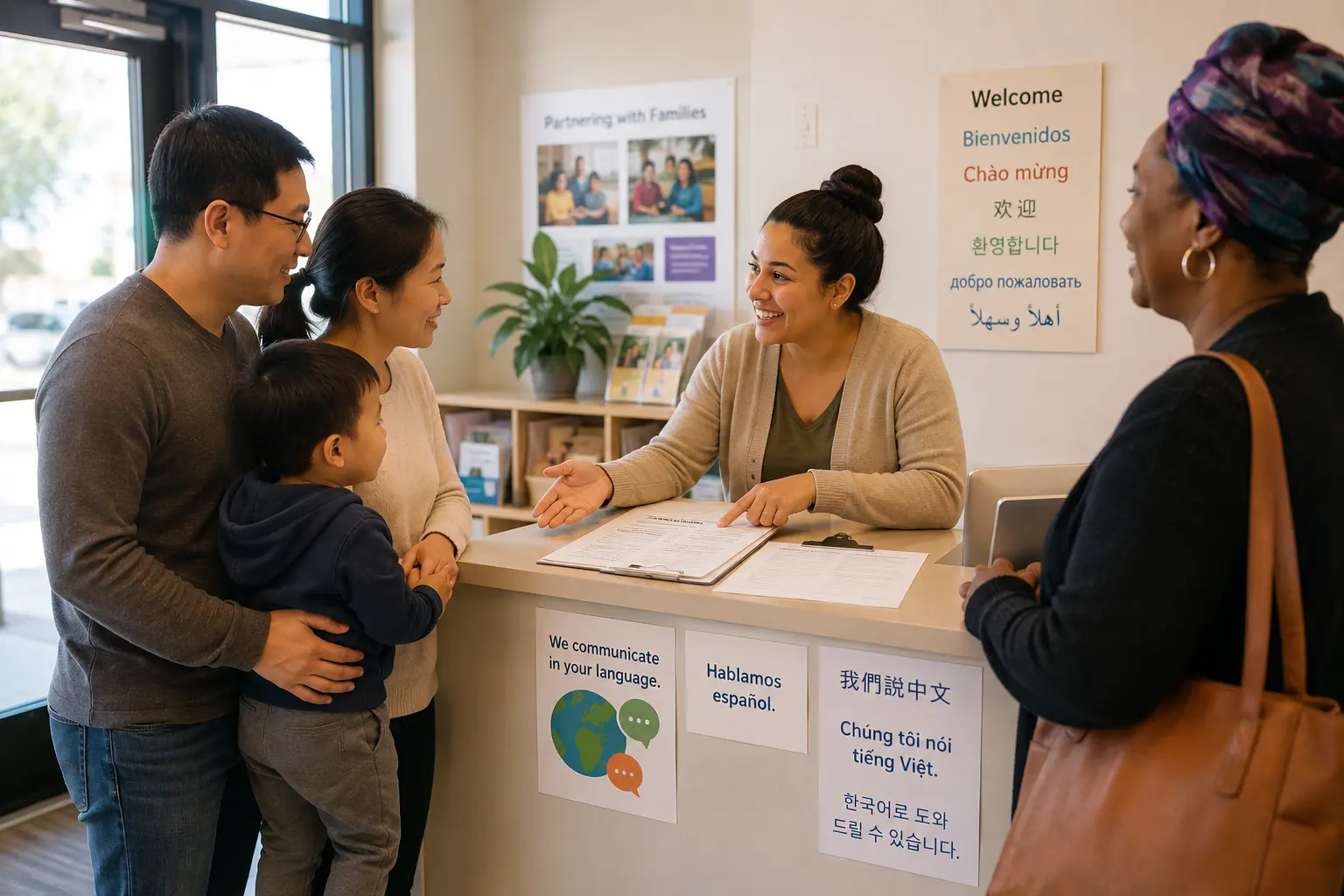
Communicating with families is crucial to building trust in your child care business and helping children in your care develop to their fullest potential, but clarity can be difficult when multiple languages are at play. The Migration Policy Institute cites that roughly one in three children under age five in the U.S. is learning more than one language at home, and that 42% of these children have at least one parent who struggles with English.
That is a chance to address pain points for many potential families to grow enrollment. Without translation, these families may face a daily communications challenge: parents need to understand classroom updates, and inquiry calls cannot go unanswered because no one on duty speaks the caller’s language.
Playground gives multilingual programs a practical setup, including an English/Spanish app for everyday use, tap-to-translate in family communications, and Camber AI to recognize and interact with prospective families in a variety of languages on the phone.
Want to see Playground’s communication features in action? Book a free demo.
An app families and staff can actually use
Parents and staff can set the Playground app and dashboard to English or Spanish. Menus, buttons, and labels follow that choice, so bilingual teams and Spanish-speaking families can work in the language they prefer.
Family chat and the activity feed, without extra tools
Instead of copying messages into a separate translator, teachers in the Playground chat and activity feed can tap Translate on a message they receive in family-to-staff chat and staff-to-staff chat. On mobile, if a user’s phone is set to a language other than English, translation can target that device language. Google powers the translation in the background, so the range of readable languages is broader than the English/Spanish app UI.
For most classrooms, that is enough to keep Spanish-speaking and other-language families in the loop on the updates that matter.
Camber AI meets new families in their language
The biggest language gap is often the first phone call. Camber, Playground’s AI voice agent, is built for that moment. Centers can set a primary language plus additional languages. On a live call, Camber can detect the caller’s language and respond in it. Staff can also use Translate to all to generate the opening greeting in each extra language.
Camber voice AI currently supports:
English
Spanish
French
German
Italian
Portuguese
Dutch
Polish
Hindi
Japanese
Korean
Chinese
Camber is the feature designed to handle multilingual outreach in real time, including after hours, so a family is less likely to hang up and call another center.
Summary: Playground translation and multilingual features
Feature | Who it helps | What it does |
App and dashboard | Staff and parents | English or Spanish interface |
Chat translation | Staff and parents | Tap to translate received text messages; mobile can use the phone’s language |
Feed translation | Staff and parents | Tap to translate plain-text posts |
Camber AI voice | Prospective and current families | Detects language on calls and can speak a wider set of languages |
The bottom line
For Spanish speaking staff and families on Playground, the app can be switched entirely to Spanish. Keep important feed updates in plain text if you want them translatable. Show staff that Translate is there when they need to read a message. Then turn on Camber’s extra languages so inquiry calls are not limited to whoever happens to pick up. Playground works well for what multilingual centers actually need: a bilingual product for daily use, easy translation in the family app, and one of the best AI voice agents that can make more families feel welcome from the first call.
See it in your own enrollment flow. Book a Playground demo.
Communicating with families is crucial to building trust in your child care business and helping children in your care develop to their fullest potential, but clarity can be difficult when multiple languages are at play. The Migration Policy Institute cites that roughly one in three children under age five in the U.S. is learning more than one language at home, and that 42% of these children have at least one parent who struggles with English.
That is a chance to address pain points for many potential families to grow enrollment. Without translation, these families may face a daily communications challenge: parents need to understand classroom updates, and inquiry calls cannot go unanswered because no one on duty speaks the caller’s language.
Playground gives multilingual programs a practical setup, including an English/Spanish app for everyday use, tap-to-translate in family communications, and Camber AI to recognize and interact with prospective families in a variety of languages on the phone.
Want to see Playground’s communication features in action? Book a free demo.
An app families and staff can actually use
Parents and staff can set the Playground app and dashboard to English or Spanish. Menus, buttons, and labels follow that choice, so bilingual teams and Spanish-speaking families can work in the language they prefer.
Family chat and the activity feed, without extra tools
Instead of copying messages into a separate translator, teachers in the Playground chat and activity feed can tap Translate on a message they receive in family-to-staff chat and staff-to-staff chat. On mobile, if a user’s phone is set to a language other than English, translation can target that device language. Google powers the translation in the background, so the range of readable languages is broader than the English/Spanish app UI.
For most classrooms, that is enough to keep Spanish-speaking and other-language families in the loop on the updates that matter.
Camber AI meets new families in their language
The biggest language gap is often the first phone call. Camber, Playground’s AI voice agent, is built for that moment. Centers can set a primary language plus additional languages. On a live call, Camber can detect the caller’s language and respond in it. Staff can also use Translate to all to generate the opening greeting in each extra language.
Camber voice AI currently supports:
English
Spanish
French
German
Italian
Portuguese
Dutch
Polish
Hindi
Japanese
Korean
Chinese
Camber is the feature designed to handle multilingual outreach in real time, including after hours, so a family is less likely to hang up and call another center.
Summary: Playground translation and multilingual features
Feature | Who it helps | What it does |
App and dashboard | Staff and parents | English or Spanish interface |
Chat translation | Staff and parents | Tap to translate received text messages; mobile can use the phone’s language |
Feed translation | Staff and parents | Tap to translate plain-text posts |
Camber AI voice | Prospective and current families | Detects language on calls and can speak a wider set of languages |
The bottom line
For Spanish speaking staff and families on Playground, the app can be switched entirely to Spanish. Keep important feed updates in plain text if you want them translatable. Show staff that Translate is there when they need to read a message. Then turn on Camber’s extra languages so inquiry calls are not limited to whoever happens to pick up. Playground works well for what multilingual centers actually need: a bilingual product for daily use, easy translation in the family app, and one of the best AI voice agents that can make more families feel welcome from the first call.
See it in your own enrollment flow. Book a Playground demo.
Jaclyn is a data journalist and CFP™ who evaluates trends in the childcare industry and wider economy. She has previously worked for publications including CNET, SmartAsset, Bizfluent, AZCentral and Chron, and as a research consultant for NAPCO Media. Her insights are often cited by publications including Bloomberg, CNBC, Business Insider, Fox News, USA Today, The Hill and more. She has a bachelor’s degree in economics and mathematics from The College of New Jersey.
Share this article
The highest rated child care software
Ratings and review counts from public app store listings, May 2026.



Book a demo and simplify every corner of your business.




Book a demo and simplify every corner of your business.
