

QRIS Guide for Child Care Directors: State Contacts and Ratings Explained
QRIS Guide for Child Care Directors: State Contacts and Ratings Explained
QRIS Guide for Child Care Directors: State Contacts and Ratings Explained

Last updated:
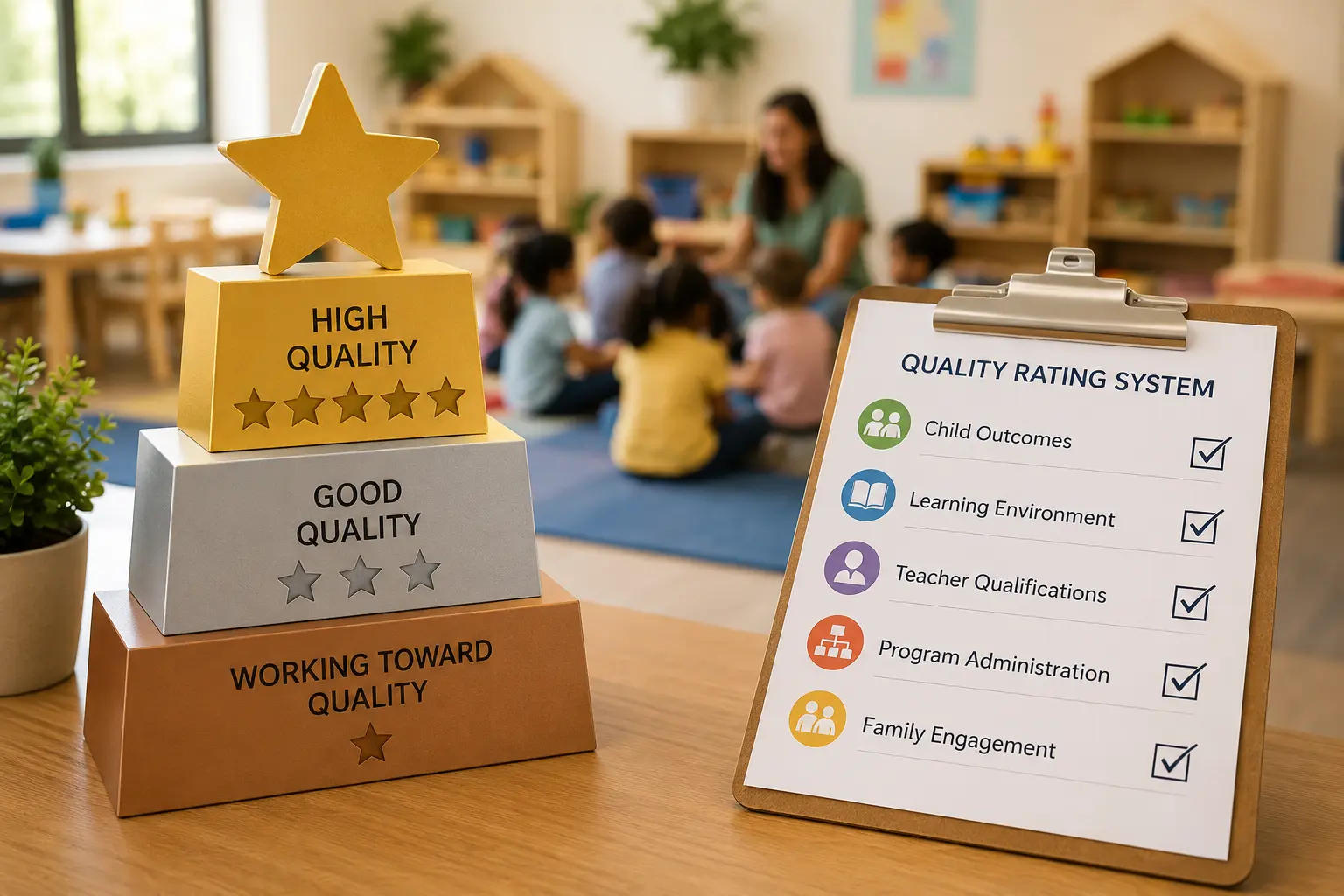
As a child care director or program leader, you have a practical interest in tools that help your program stand out. Quality Rating and Improvement Systems (QRIS) offer a structured framework many states use to evaluate, support, and recognize programs that go beyond minimum licensing requirements. Understanding QRIS can help you access resources, improve outcomes, and strengthen your program’s sustainability. Participating may unlock funding or other incentives.
In practice, QRIS systems are designed to raise quality standards in early childhood education above basic licensing rules. Each statewide QRIS program has its own name and protocols. In addition to more information about how QRIS works, this article includes the names and contact information for every state’s program.
Looking for efficient ways to increase your program’s care and operational quality? Book a free demo with Playground.
What Is a QRIS?
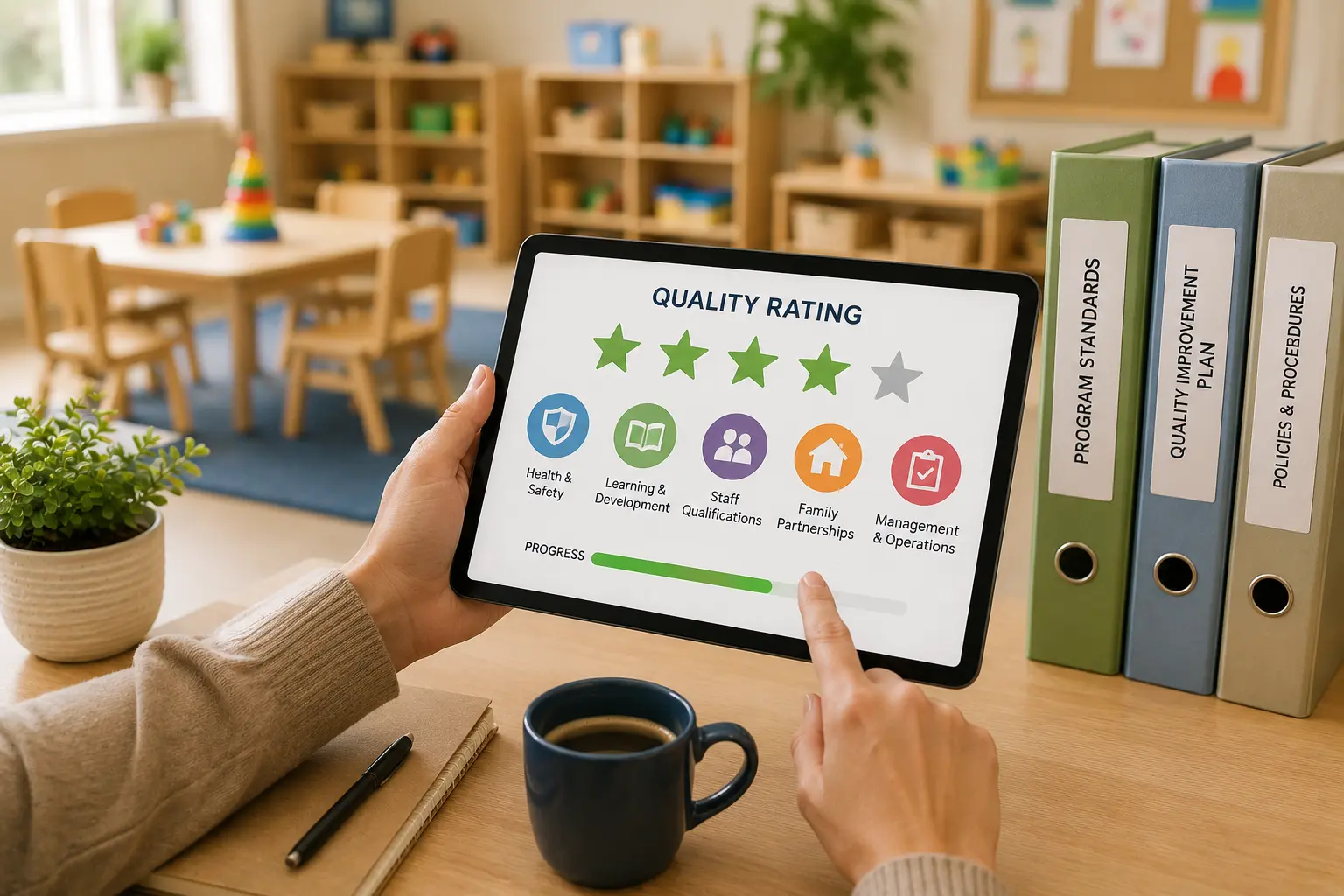
A QRIS is a state-level system that assesses early childhood programs (centers, family child care homes, preschools, and sometimes school-age care) across multiple quality indicators. It rates programs – often with stars or levels – and connects higher ratings to supports like coaching, training, and financial incentives. Most QRIS evaluate areas such as:
Staff qualifications and professional development
Curriculum, learning environments, and child assessments
Teacher-child interactions (often observed with tools like CLASS)
Family engagement and partnerships
Program leadership, administration, and health/safety practices
Level 1 typically aligns with basic licensing, while higher levels require stronger ratios, more educated staff, proven practices, and documentation of quality. However, it’s important to note that systems vary significantly by state. A 4-star rating in one state does not equal a 4-star in another. Always check your state’s specific standards.
Do You Need to Enroll Your Program?
Participation is usually voluntary, but it’s increasingly tied to subsidy and grant funding. Many states require QRIS enrollment (or a minimum rating) for providers accepting child care subsidies (CCDF), grants, or other public funds. Even without mandates, higher-rated programs often qualify for:
Tiered reimbursement rates (higher payments per subsidized child)
Quality improvement grants or bonuses
Priority access to certain contracts or professional development opportunities
If your program serves subsidized families or seeks growth, QRIS is often a practical necessity rather than an optional add-on. A positive QRIS rating can also help attract qualified staff and serve as a marketing tool for prospective client families.
For programs already operating near capacity without subsidized families, the return on that investment may be slower. Whether it’s worth it generally depends on how much of your enrollment relies on subsidy funding and how close your current practices already are to the rating standards.
How long does it take to get a top QRIS rating?
Timeline varies by state and your program’s starting point, but most providers should expect the process to take anywhere from several months to a couple of years to reach a top rating, depending on how many quality indicators need to be improved. The initial application and documentation phase typically takes a few weeks to months. Observation scheduling, review periods, and coaching cycles add additional time. Programs that are already close to meeting the standards – for example, those with credentialed staff and strong curricula in place – can move more quickly. States often allow you to work toward improvement over time rather than meeting all standards before being rated.
Does It Cost Money to Participate in a QRIS?
Direct enrollment fees are rare or low in most states – many systems are funded publicly and charge nothing (or a nominal amount) for the rating process itself.
Indirect costs are the real consideration:
Time for documentation, self-assessments, and observations
Investments in staff education, training, or materials to meet higher standards
Potential temporary adjustments to ratios or scheduling during improvement phases
These costs are often offset by incentives, coaching supports (frequently free), and higher reimbursements. Many directors report that structured support helps them make targeted investments that pay off through better retention, enrollment, and outcomes.
Steps to Enroll and Maintain Compliance
While details differ by state, the general process looks like this:
Research your state’s system. Visit your state’s child care licensing website (listed below) or the national Quality Compendium for your state profile. Contact your local Child Care Resource and Referral (CCR&R) agency for personalized guidance.
Attend an orientation. Most states offer free sessions, whether in-person or virtual, that explain standards, the rating process, and available support.
Complete a self-assessment. Use your state’s tools to evaluate your current practices against the standards. Identify strengths and gaps.
Submit an application. You’ll have to provide documentation such as policies, staff credentials, curriculum details, observation results, etc. Some systems integrate with licensing databases for efficiency.
Undergo review and rating. This may include classroom observations, portfolio reviews, or verification visits. Many states use a points-based or block system.
Develop and implement an improvement plan. Work with assigned coaches or mentors on targeted goals. Coaching is one of the most valuable (and often free) parts of QRIS.
How do I maintain my QRIS standing?
Ongoing QRIS participation requirements will vary by state, but most ratings are typically valid for one to three years. In order to stay in good standing, many system require annual updates, professional development (PD) hours, or progress reports. To this end, make sure you track any improvements you make to your operational systems, and any staff training.
Consider using Playground to improve your operations, care quality and bottom line. Book a free demo today.
QRIS programs and contact information by state
Alabama
QRIS: Alabama Quality STARS
Website: alabamaqualitystars.org
Phone: (334) 604-6260
Email: info@alabamaqualitystars.org
Alaska
QRIS: Learn & Grow
Website: threadalaska.org/learn-and-grow
Phone: 907-265-3100
Email: info@threadalaska.org
Arizona
QRIS: Quality First
Website: qualityfirstaz.com
Phone: 602.771.5000
Email: QualityFirst@FirstThingsFirst.org
Arkansas
QRIS: Better Beginnings
Website: arbetterbeginnings.com
Phone: 1-501-320-6161
California
QRIS: Quality Counts California (QCC) — statewide framework with local/county implementation
Website: qualitycountsca.net
Colorado
QRIS: Colorado Shines
Website: coloradoshines.com
Phones:
Referral Line: 877-338-2273
Help Desk: 844-447-4441
Email:
QRIS related: cdec_coshines@state.co.us
PDIS related: cdec_pdishelp@state.co.us
Connecticut
QRIS: Elevate
Website: ctoec.org/elevate
Phone: 860-500-4412
Delaware
QRIS: Delaware Stars for Early Success (DE Stars)
Website: mychildde.org/providers/quality
Phone: (800) 734-2388
Email: mychildde@cffde.org
District of Columbia
QRIS: Capital Quality
Phone: (202) 727-6436
Email: osse@dc.gov
Florida
No traditional single statewide QRIS. Quality is addressed through School Readiness and Voluntary Prekindergarten (VPK) program assessments, plus various county/local systems.
Main resource: Florida Office of Early Learning / local Child Care Resource & Referral agencies
Georgia
QRIS: Quality Rated
Phone: 1-888-442-7735
Hawaii
No formal statewide QRIS. Pilot program may be available.
Idaho
QRIS: Quality Achievers (current system via IdahoSTARS; previously Steps to Quality)
Website: idahostars.org
Phone: 1-800-926-2588
Illinois
QRIS: ExceleRate Illinois
Website: excelerateillinois.com
Phone: 866-697-8278
Indiana
QRIS: Paths to QUALITY
Website: in.gov/fssa/pathstoquality
Phone: 800-299-1627
Iowa
QRIS: Iowa Quality for Kids (IQ4K)
Website: iowaccrr.org/providers/iq4k
Contact form: https://iowaccrr.org/contact/
Kansas
QRIS: Links to Quality (L2Q)
Website: ks.childcareaware.org/l2q
Phone: 785-823-3343
Email: info@ks.childcareaware.org
Kentucky
QRIS: Kentucky All STARS
Website: chfs.ky.gov/agencies/dcbs/dcc/Pages/kyallstars.aspx (families)Provider resources also available on the same site.
Phone: (502) 564-5497
Louisiana
QRIS: Performance Profiles
Website: doe.louisiana.gov/early-childhood/performance-profiles(Profiles also at louisianaschools.com)
Phone: 1-877-453-2721
Maine
QRIS: Rising Stars for ME
Website: risingstarsforme.org(Also: maine.gov/dhhs/ocfs/support-for-families/child-care/qris)
Phone: 1-888-900-0055
Email: risingstarsforme@maine.edu
Maryland
QRIS: Maryland EXCELS
Website: marylandexcels.org
Email: info@marylandexcels.org
Massachusetts
QRIS: Currently paused while developing a continuous quality improvement system.
Main agency: Department of Early Education and Care (EEC)
Website: mass.gov/orgs/department-of-early-education-and-care
Michigan
QRIS: Great Start to Quality
Website: greatstarttoquality.org
Phone: 1-877-614-7328
Email: greatstarttoquality@ecic4kids.org
Minnesota
QRIS: Parent Aware
Website: parentaware.org
Phone: 888-291-9811
Missouri
QRIS: Quality Assurance Report (QAR)
Website: dese.mo.gov/childhood/quality-programs/quality-assurance-report
Phone: 573-751-6793
Email: Childhood@dese.mo.gov
Montana
QRIS: Montana’s Treasures (Launching Oct. 1, 2026)
Phone: 406-444-5622
Nebraska
QRIS: Step Up to Quality
Website: stepuptoquality.ne.gov
Phone: 844-807-5712
Email: nde.stepuptoquality@nebraska.gov
Nevada
QRIS: Silver State Stars
Website: https://doe.nv.gov/offices/oeld/ece-professionals/qris
Phone: 702-486-6458
Email: QRIS@doe.nv.gov
New Hampshire
QRIS: Granite Steps for Quality
Phone: 603-271-4242
Email: NHGSQ@dhhs.nh.gov
New Jersey
QRIS: Grow NJ Kids
Website: grownjkids.gov
New Mexico
QRIS: FOCUS
Website: https://www.nmececd.org/focus-tqris/
Phone: 505-695-6804
Email: Rosario.Roybal@ececd.nm.gov
New York
QRIS: QUALITYstarsNY
Website: qualitystarsny.org
Phone: (718) 254-7727
Email: info@qualitystarsny.org
North Carolina
QRIS: Pathways to the Stars
Website: ncchildcare.ncdhhs.gov
Phone: 919-814-6300
Ohio
QRIS: Step Up to Quality
Website: https://childrenandyouth.ohio.gov/for-providers/step-up-to-quality
Phone: 844-234-5437
Email: childcarepolicy@childrenandyouth.ohio.gov
Oklahoma
QRIS: Stars program
Website: https://oklahoma.gov/okdhs/services/child-care-services/qris.html
Phone: 405-522-5050
Oregon
QRIS: Spark
Website: https://oregonspark.org/
Phone: 877-768-8290
Email: oregonspark@wou.edu
Pennsylvania
QRIS: Keystone STARS
Phone: 844-569-7253
Email: info@pakeys.org
Rhode Island
QRIS: BrightStars
Website: https://brightstars.org/
Phone: 401-739-6100
Email: info@RIAEYC.org
South Carolina
QRIS: ABC Quality
Website: https://www.scchildcare.org/programs/abc-quality-rating-improvement-system/
Phone: 800-763-2223
Email: abcquality@dss.sc.gov
South Dakota
QRIS: Quality Care South Dakota
Phone: 605-688-5730
Email: SDSU.SDQRIS@sdstate.edu
Tennessee
QRIS: Star Quality Child Care Program
Website: https://www.kidcentraltn.com/support/child-care/child-care-star-rating-system.html
Texas
QRIS: Texas Rising Star
Website: https://texasrisingstardrc.org/
Phone: 800-628-5115
Utah
QRIS: Child Care Quality System
Resource page: https://jobs.utah.gov/occ/provider/quality.html
Phone: 866-435-7414
Email: ccqs@utah.gov
Vermont
QRIS: STARS
Phone: 800-649-2642, option 8
Email: STARS@vermont.gov
Virginia
QRIS: VQB5 (Virginia Quality Birth to Five)
Phone: 804-358-8323
Washington
QRIS: Early Achievers
Website: https://dcyf.wa.gov/services/earlylearning-childcare/early-achievers/rating-system
Email: qris@dcyf.wa.gov
West Virginia
QRIS: No formal QRIS system; tiered reimbursement system instead
Website: https://bfa.wv.gov/page/tiered-reimbursementSee also: https://www.wvearlychildhood.org/wv-quality-support-services
Phone: 304-637-5560
Email: jaime.l.price@wv.gov
Wisconsin
QRIS: YoungStar
Website: https://dcf.wisconsin.gov/youngstar
Phone: 833-964-7827
Email: help@youngstarconnect.com
Wyoming
QRIS: WY Quality Counts
Website: https://dws.wyo.gov/dws-division/business-training-support-unit/wyoming-quality-counts/
Phone: 307-777-2439
Email: denise.steele@wyo.gov
Remember, Playground offers a variety of ways to improve the quality of your child care program. Book a free demo today to learn more.
As a child care director or program leader, you have a practical interest in tools that help your program stand out. Quality Rating and Improvement Systems (QRIS) offer a structured framework many states use to evaluate, support, and recognize programs that go beyond minimum licensing requirements. Understanding QRIS can help you access resources, improve outcomes, and strengthen your program’s sustainability. Participating may unlock funding or other incentives.
In practice, QRIS systems are designed to raise quality standards in early childhood education above basic licensing rules. Each statewide QRIS program has its own name and protocols. In addition to more information about how QRIS works, this article includes the names and contact information for every state’s program.
Looking for efficient ways to increase your program’s care and operational quality? Book a free demo with Playground.
What Is a QRIS?
A QRIS is a state-level system that assesses early childhood programs (centers, family child care homes, preschools, and sometimes school-age care) across multiple quality indicators. It rates programs – often with stars or levels – and connects higher ratings to supports like coaching, training, and financial incentives. Most QRIS evaluate areas such as:
Staff qualifications and professional development
Curriculum, learning environments, and child assessments
Teacher-child interactions (often observed with tools like CLASS)
Family engagement and partnerships
Program leadership, administration, and health/safety practices
Level 1 typically aligns with basic licensing, while higher levels require stronger ratios, more educated staff, proven practices, and documentation of quality. However, it’s important to note that systems vary significantly by state. A 4-star rating in one state does not equal a 4-star in another. Always check your state’s specific standards.
Do You Need to Enroll Your Program?
Participation is usually voluntary, but it’s increasingly tied to subsidy and grant funding. Many states require QRIS enrollment (or a minimum rating) for providers accepting child care subsidies (CCDF), grants, or other public funds. Even without mandates, higher-rated programs often qualify for:
Tiered reimbursement rates (higher payments per subsidized child)
Quality improvement grants or bonuses
Priority access to certain contracts or professional development opportunities
If your program serves subsidized families or seeks growth, QRIS is often a practical necessity rather than an optional add-on. A positive QRIS rating can also help attract qualified staff and serve as a marketing tool for prospective client families.
For programs already operating near capacity without subsidized families, the return on that investment may be slower. Whether it’s worth it generally depends on how much of your enrollment relies on subsidy funding and how close your current practices already are to the rating standards.
How long does it take to get a top QRIS rating?
Timeline varies by state and your program’s starting point, but most providers should expect the process to take anywhere from several months to a couple of years to reach a top rating, depending on how many quality indicators need to be improved. The initial application and documentation phase typically takes a few weeks to months. Observation scheduling, review periods, and coaching cycles add additional time. Programs that are already close to meeting the standards – for example, those with credentialed staff and strong curricula in place – can move more quickly. States often allow you to work toward improvement over time rather than meeting all standards before being rated.
Does It Cost Money to Participate in a QRIS?
Direct enrollment fees are rare or low in most states – many systems are funded publicly and charge nothing (or a nominal amount) for the rating process itself.
Indirect costs are the real consideration:
Time for documentation, self-assessments, and observations
Investments in staff education, training, or materials to meet higher standards
Potential temporary adjustments to ratios or scheduling during improvement phases
These costs are often offset by incentives, coaching supports (frequently free), and higher reimbursements. Many directors report that structured support helps them make targeted investments that pay off through better retention, enrollment, and outcomes.
Steps to Enroll and Maintain Compliance
While details differ by state, the general process looks like this:
Research your state’s system. Visit your state’s child care licensing website (listed below) or the national Quality Compendium for your state profile. Contact your local Child Care Resource and Referral (CCR&R) agency for personalized guidance.
Attend an orientation. Most states offer free sessions, whether in-person or virtual, that explain standards, the rating process, and available support.
Complete a self-assessment. Use your state’s tools to evaluate your current practices against the standards. Identify strengths and gaps.
Submit an application. You’ll have to provide documentation such as policies, staff credentials, curriculum details, observation results, etc. Some systems integrate with licensing databases for efficiency.
Undergo review and rating. This may include classroom observations, portfolio reviews, or verification visits. Many states use a points-based or block system.
Develop and implement an improvement plan. Work with assigned coaches or mentors on targeted goals. Coaching is one of the most valuable (and often free) parts of QRIS.
How do I maintain my QRIS standing?
Ongoing QRIS participation requirements will vary by state, but most ratings are typically valid for one to three years. In order to stay in good standing, many system require annual updates, professional development (PD) hours, or progress reports. To this end, make sure you track any improvements you make to your operational systems, and any staff training.
Consider using Playground to improve your operations, care quality and bottom line. Book a free demo today.
QRIS programs and contact information by state
Alabama
QRIS: Alabama Quality STARS
Website: alabamaqualitystars.org
Phone: (334) 604-6260
Email: info@alabamaqualitystars.org
Alaska
QRIS: Learn & Grow
Website: threadalaska.org/learn-and-grow
Phone: 907-265-3100
Email: info@threadalaska.org
Arizona
QRIS: Quality First
Website: qualityfirstaz.com
Phone: 602.771.5000
Email: QualityFirst@FirstThingsFirst.org
Arkansas
QRIS: Better Beginnings
Website: arbetterbeginnings.com
Phone: 1-501-320-6161
California
QRIS: Quality Counts California (QCC) — statewide framework with local/county implementation
Website: qualitycountsca.net
Colorado
QRIS: Colorado Shines
Website: coloradoshines.com
Phones:
Referral Line: 877-338-2273
Help Desk: 844-447-4441
Email:
QRIS related: cdec_coshines@state.co.us
PDIS related: cdec_pdishelp@state.co.us
Connecticut
QRIS: Elevate
Website: ctoec.org/elevate
Phone: 860-500-4412
Delaware
QRIS: Delaware Stars for Early Success (DE Stars)
Website: mychildde.org/providers/quality
Phone: (800) 734-2388
Email: mychildde@cffde.org
District of Columbia
QRIS: Capital Quality
Phone: (202) 727-6436
Email: osse@dc.gov
Florida
No traditional single statewide QRIS. Quality is addressed through School Readiness and Voluntary Prekindergarten (VPK) program assessments, plus various county/local systems.
Main resource: Florida Office of Early Learning / local Child Care Resource & Referral agencies
Georgia
QRIS: Quality Rated
Phone: 1-888-442-7735
Hawaii
No formal statewide QRIS. Pilot program may be available.
Idaho
QRIS: Quality Achievers (current system via IdahoSTARS; previously Steps to Quality)
Website: idahostars.org
Phone: 1-800-926-2588
Illinois
QRIS: ExceleRate Illinois
Website: excelerateillinois.com
Phone: 866-697-8278
Indiana
QRIS: Paths to QUALITY
Website: in.gov/fssa/pathstoquality
Phone: 800-299-1627
Iowa
QRIS: Iowa Quality for Kids (IQ4K)
Website: iowaccrr.org/providers/iq4k
Contact form: https://iowaccrr.org/contact/
Kansas
QRIS: Links to Quality (L2Q)
Website: ks.childcareaware.org/l2q
Phone: 785-823-3343
Email: info@ks.childcareaware.org
Kentucky
QRIS: Kentucky All STARS
Website: chfs.ky.gov/agencies/dcbs/dcc/Pages/kyallstars.aspx (families)Provider resources also available on the same site.
Phone: (502) 564-5497
Louisiana
QRIS: Performance Profiles
Website: doe.louisiana.gov/early-childhood/performance-profiles(Profiles also at louisianaschools.com)
Phone: 1-877-453-2721
Maine
QRIS: Rising Stars for ME
Website: risingstarsforme.org(Also: maine.gov/dhhs/ocfs/support-for-families/child-care/qris)
Phone: 1-888-900-0055
Email: risingstarsforme@maine.edu
Maryland
QRIS: Maryland EXCELS
Website: marylandexcels.org
Email: info@marylandexcels.org
Massachusetts
QRIS: Currently paused while developing a continuous quality improvement system.
Main agency: Department of Early Education and Care (EEC)
Website: mass.gov/orgs/department-of-early-education-and-care
Michigan
QRIS: Great Start to Quality
Website: greatstarttoquality.org
Phone: 1-877-614-7328
Email: greatstarttoquality@ecic4kids.org
Minnesota
QRIS: Parent Aware
Website: parentaware.org
Phone: 888-291-9811
Missouri
QRIS: Quality Assurance Report (QAR)
Website: dese.mo.gov/childhood/quality-programs/quality-assurance-report
Phone: 573-751-6793
Email: Childhood@dese.mo.gov
Montana
QRIS: Montana’s Treasures (Launching Oct. 1, 2026)
Phone: 406-444-5622
Nebraska
QRIS: Step Up to Quality
Website: stepuptoquality.ne.gov
Phone: 844-807-5712
Email: nde.stepuptoquality@nebraska.gov
Nevada
QRIS: Silver State Stars
Website: https://doe.nv.gov/offices/oeld/ece-professionals/qris
Phone: 702-486-6458
Email: QRIS@doe.nv.gov
New Hampshire
QRIS: Granite Steps for Quality
Phone: 603-271-4242
Email: NHGSQ@dhhs.nh.gov
New Jersey
QRIS: Grow NJ Kids
Website: grownjkids.gov
New Mexico
QRIS: FOCUS
Website: https://www.nmececd.org/focus-tqris/
Phone: 505-695-6804
Email: Rosario.Roybal@ececd.nm.gov
New York
QRIS: QUALITYstarsNY
Website: qualitystarsny.org
Phone: (718) 254-7727
Email: info@qualitystarsny.org
North Carolina
QRIS: Pathways to the Stars
Website: ncchildcare.ncdhhs.gov
Phone: 919-814-6300
Ohio
QRIS: Step Up to Quality
Website: https://childrenandyouth.ohio.gov/for-providers/step-up-to-quality
Phone: 844-234-5437
Email: childcarepolicy@childrenandyouth.ohio.gov
Oklahoma
QRIS: Stars program
Website: https://oklahoma.gov/okdhs/services/child-care-services/qris.html
Phone: 405-522-5050
Oregon
QRIS: Spark
Website: https://oregonspark.org/
Phone: 877-768-8290
Email: oregonspark@wou.edu
Pennsylvania
QRIS: Keystone STARS
Phone: 844-569-7253
Email: info@pakeys.org
Rhode Island
QRIS: BrightStars
Website: https://brightstars.org/
Phone: 401-739-6100
Email: info@RIAEYC.org
South Carolina
QRIS: ABC Quality
Website: https://www.scchildcare.org/programs/abc-quality-rating-improvement-system/
Phone: 800-763-2223
Email: abcquality@dss.sc.gov
South Dakota
QRIS: Quality Care South Dakota
Phone: 605-688-5730
Email: SDSU.SDQRIS@sdstate.edu
Tennessee
QRIS: Star Quality Child Care Program
Website: https://www.kidcentraltn.com/support/child-care/child-care-star-rating-system.html
Texas
QRIS: Texas Rising Star
Website: https://texasrisingstardrc.org/
Phone: 800-628-5115
Utah
QRIS: Child Care Quality System
Resource page: https://jobs.utah.gov/occ/provider/quality.html
Phone: 866-435-7414
Email: ccqs@utah.gov
Vermont
QRIS: STARS
Phone: 800-649-2642, option 8
Email: STARS@vermont.gov
Virginia
QRIS: VQB5 (Virginia Quality Birth to Five)
Phone: 804-358-8323
Washington
QRIS: Early Achievers
Website: https://dcyf.wa.gov/services/earlylearning-childcare/early-achievers/rating-system
Email: qris@dcyf.wa.gov
West Virginia
QRIS: No formal QRIS system; tiered reimbursement system instead
Website: https://bfa.wv.gov/page/tiered-reimbursementSee also: https://www.wvearlychildhood.org/wv-quality-support-services
Phone: 304-637-5560
Email: jaime.l.price@wv.gov
Wisconsin
QRIS: YoungStar
Website: https://dcf.wisconsin.gov/youngstar
Phone: 833-964-7827
Email: help@youngstarconnect.com
Wyoming
QRIS: WY Quality Counts
Website: https://dws.wyo.gov/dws-division/business-training-support-unit/wyoming-quality-counts/
Phone: 307-777-2439
Email: denise.steele@wyo.gov
Remember, Playground offers a variety of ways to improve the quality of your child care program. Book a free demo today to learn more.
Jaclyn is a data journalist and CFP™ who evaluates trends in the childcare industry and wider economy. She has previously worked for publications including CNET, SmartAsset, Bizfluent, AZCentral and Chron, and as a research consultant for NAPCO Media. Her insights are often cited by publications including Bloomberg, CNBC, Business Insider, Fox News, USA Today, The Hill and more. She has a bachelor’s degree in economics and mathematics from The College of New Jersey.
Share this article
The highest rated child care software
Ratings and review counts from public app store listings, May 2026.

Book a demo and simplify every corner of your business.



Book a demo and simplify every corner of your business.
